This blog post shares highlights of the exposure visit in Gujarat that the author was able to undertake due to the Professional Development Grant as part of the Banyan Impact Fellowship program. The blog shares insights of an enriching two-day field visit to AIF Digital Equalizer sites in Gujarat. The PDG opportunity is provided to Fellows during the Fellowship period and aims to expand perspectives on the development sector or aid in Fellow’s professional and personal growth. The grant allowed me to explore beyond my host organization and collaborate with AIF’s Education Program.
About AIF Digital Equalizer
AIF’s Digital Equalizer (DE), a digitally enabled program in India, aims to overcome the digital and education gap by training students from government schools to succeed in the technologically driven world. DE is designed for students between grades 6 to 12 and ensures that the delivery of education is technologically-driven and teacher-led. The DE-based curriculum focuses on using STEM pedagogy and model-based learning. DE has also developed an EduKit,- a video-based learning platform that has concept videos taught through scenario/activity-based learning. The aim of AIF’s DE program is to involve, uplift and strengthen children’s educational experience, utilizing technology.

Background and Purpose of Visit
My placement through the Fellowship is with the Vidya Sahyog Program, a digital education initiative run by the Lotus Petal Foundation in Gurgaon, Haryana. Vidya Sahyog aims to address educational disparities by offering virtual foundational literacy and numeracy classes, tailored to individual needs. Currently operational in nine states across India, Vidya Sahyog collaborates with government schools, private affordable schools, and NGO schools to provide digitally equipped infrastructure for seamless class delivery.
During my research, I’ve observed the transformative impact of technology on education and development sectors, leading to pedagogical innovations. While Vidya Sahyog currently operates on an online teaching model, the rapid growth of Ed-tech raises questions and opens possibilities about efficient technology integration and effective delivery of learning outcomes.

Purpose of the Visit
The objective of my visit to the AIF Digital Equalizer program was to explore its integrated approach to technology, focusing on content quality, delivery channels, digital literacy solutions, and teacher training. Interacting with beneficiaries and stakeholders provided valuable insights into the program’s successes and challenges. Additionally, the visit aimed to understand the introduction of STEM education in schools, aligning with Vidya Sahyog’s future goals.
Day 1
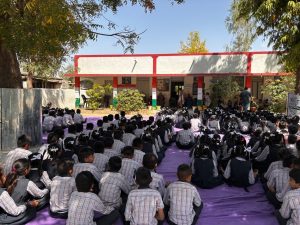
On the first day of my visit, I travelled to the Sabargatha district in Gandhinagar, 70 kilometres from Ahmedabad. Accompanied by the DE team, I was briefed on the schedule, our interests, our association with AIF, and an overview of their work, preparing me for a day of learning. Upon arrival at the school, the morning assembly greeted us with a rhythmic energy. Led entirely by students, from the music to the hymns and rhythmic claps, the atmosphere exuded positivity and grace. Witnessing the students’ active participation and their connection with spirituality during the assembly was my biggest highlight.
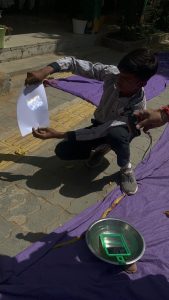
Right after the morning prayers and meditation, the students from upper primary demonstrated a science experiment during assembly on prisms and the splitting of light. With the help of Mr. Sanjay Sir, the science teacher at Bobha Primary, the students demonstrated the experiment with great enthusiasm. The experiential learning approach made the experiment more thrilling. Dispersion of Light Concept: Water served as a simple prism dispersing the light through a mirror. The rainbow (VIBGYOR) was projected onto a sheet held by a student as Sanjay Sir shared the scientific explanation with the students. Not only did Sanjay Sir explain the experiments with conceptual clarity but also added how science could be used in everyday life, helping the students gain an interest in learning more about the field.
I was fortunate to have an informal talk with Prahlaj Ji, a member of the School Management Committee, who emphasized the significance of parental involvement in school affairs. Prahlaj Ji actively participates in their child’s education and inspires other parents. As a SMC member, Prahlaj Ji argues for education in the community and works to resolve lateral problems such as absence, and dropout rates. Also, he encourages parents to participate in student and school affairs. Prahlaj Ji works in the community with parents to help them realize that students have the freedom to exercise their authority and for the parents to be aware of their child’s academic progress and learning gaps with the help of teachers. Prahlaj Ji advocates for experiential learning as the best methodology in any educational intervention. He supports the AIF- Digital Equalizer program and has noticed that his children have acquired the ability to be curious and to think scientifically as a result of the program.

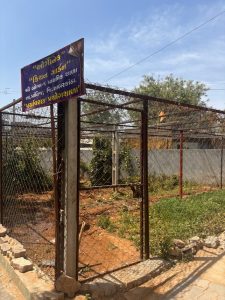
After my discussion with Prahlaj Ji, everyone present at the meeting had a taste of Sukhri (Gujarati Kaju Katli), a breakfast snack prepared by the school’s chefs and kitchen managers. Each day, the school records feedback on the snacks and meals prepared for mid-day meals. I had the chance to sample the snack and share my feedback—it was simply delicious! The school administration mentioned that they prepare different nutritious meals daily, using alternative grains like Ragi, Jowar, and Bajra instead of refined flour. Additionally, the school has a dedicated kitchen and herbal garden called Aushadi Bagh, where they grow vegetables and herbs like drumsticks, tomatoes, brinjals, and herbs like Ardusi.

Now, it was time for me to step into the shoes of a student, a new experience for someone unfamiliar with the Gujarati language. Despite my limited Gujarati comprehension, I found myself surprisingly adept in the class. The class employed a blended approach of three modalities, with the teacher at the center guiding the students through creative engagement tactics. Unlike traditional chalk-and-talk methods, the class utilized various tools like models, videos, and scenarios to engage students, making learning more dynamic and immersive.
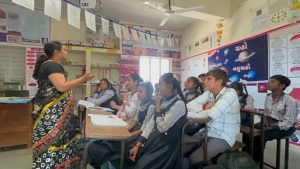

At the end of the day, I was able to take part in discussions with AIF mentors and students who have been a part of remedial classes. The remedial classes are designed for middle school students ranging from the 6th to the 8th grade. The curriculum is divided into three levels based on the competency of students. The school teachers may assign students to remedial classes based on their observations. The tutors opt for novel and interactive approaches. The remedial classes include initial tests to evaluate students’ levels and customizing a teacher method according to their needs. With progress tests conducted every two weeks, these classes aim to achieve set learning milestones within the shortest possible period. The teaching strategy of tutors is inspired by games and models developed by self or from educational tools such as the Shiksha Sagar app, G-Shala, and YouTube.


Reflections
The visit really helped me grasp a better understanding of educational interventions and the digital education scene in India. Besides learning about intervention methods, curriculum design, cool teaching techniques, and using backyard science to boost STEM awareness, I am in admiration of the teamwork. It taught me heaps about leadership and how honest collaboration both within and outside a team works wonders. Starting out in my career, I realize that one of the biggest lessons is knowing how to gel with a team and appreciate all ideas. My visit to Gujarat will always be a memorable one.


