- AIF’s S.N.E.H. Program (Skilling, Nutrition, Education, and Health) supports marginalized women, children, and adolescents with an integrated community development approach.
- It tackles poverty’s root causes through four pillars: nutrition, early education, adolescent health, and women’s skill-building via Self-Help Groups (SHGs).
- Community health workers are trained to bridge healthcare gaps, primarily working in rural child care centers (Anganwadis).
- Women in SHGs run Community Kitchens, gaining financial independence by providing nutritious meals; over 6.7 million meals served.
- Early Childhood Education is strengthened with a focus on cognitive, physical, language, and social-emotional development.
- Health workers, especially ASHAs, receive training on infant feeding practices and child illness management, with over 27,000 children assessed to date.
- The program’s success relies on community engagement and local ownership, driving sustainable and systemic change.
In Hindi, SNEH means love and care. AIF’s S.N.E.H. (Skilling, Nutrition, Education, and Health) Program is an integrated community development initiative that lives up to its acronym and has become a symbol of love and empowerment for some of India’s most vulnerable groups– marginalized women, children, and adolescents.
As the largest Indian-diaspora-led philanthropy focused on poverty alleviation in India, AIF’s mission has always been to empower India’s most vulnerable groups through multi-pronged interventions in education, public health, and livelihoods. Central to AIF’s work is strengthening the US-India corridor and nurturing the next generation of leaders who will be integral to driving sustainable, scalable change.
The Four Pillars of S.N.E.H.’s Integrated Community Development Model
Since poverty is multidimensional, our alleviation efforts must follow suit. S.N.E.H. works to address the root causes of poverty and the interconnected challenges that sustain it in the following ways:
- Combating malnutrition for children aged 6 months to 6 years
- Offering learning enrichment for the same age group
- Supporting adolescent mental health
- Empowering women to build livelihoods, financial independence, and job readiness through enhanced training in market-aligned skills through Self-Help Groups.
An integrated community development program, S.N.E.H. works to dismantle existing barriers that limit upward mobility to drive systemic, sustainable change.
The Role of Community Health Workers in S.N.E.H.’s Success
S.N.E.H.’s success depends on training and empowering community health workers to help bridge the gap between healthcare systems and vulnerable groups. It operates primarily in Anganwadis, or child care centers commonly found in India’s rural areas, to equip its community health workers to serve as caregivers who address young children’s learning needs.
Skilling
In India, where despite recent advancements, lack of gender parity continues to leave women, especially those in more remote areas, systemically out of the workforce, Self-Help Groups (SHGs)–government-run community-based organizations that provide a platform for women to join and engage in income-generating activities–offer an irreplaceable route to financial independence.
S.N.E.H. identifies and trains women in SHGS within its target communities to run Community Kitchens, where they professionally prepare and deliver nutritious meals to hundreds of children. For many women, this is the start of a life of financial independence. S.N.E.H’s approach ensures that these interventions have grassroots support and are community-led, an essential component for their long-term success and sustainability.
Nutrition
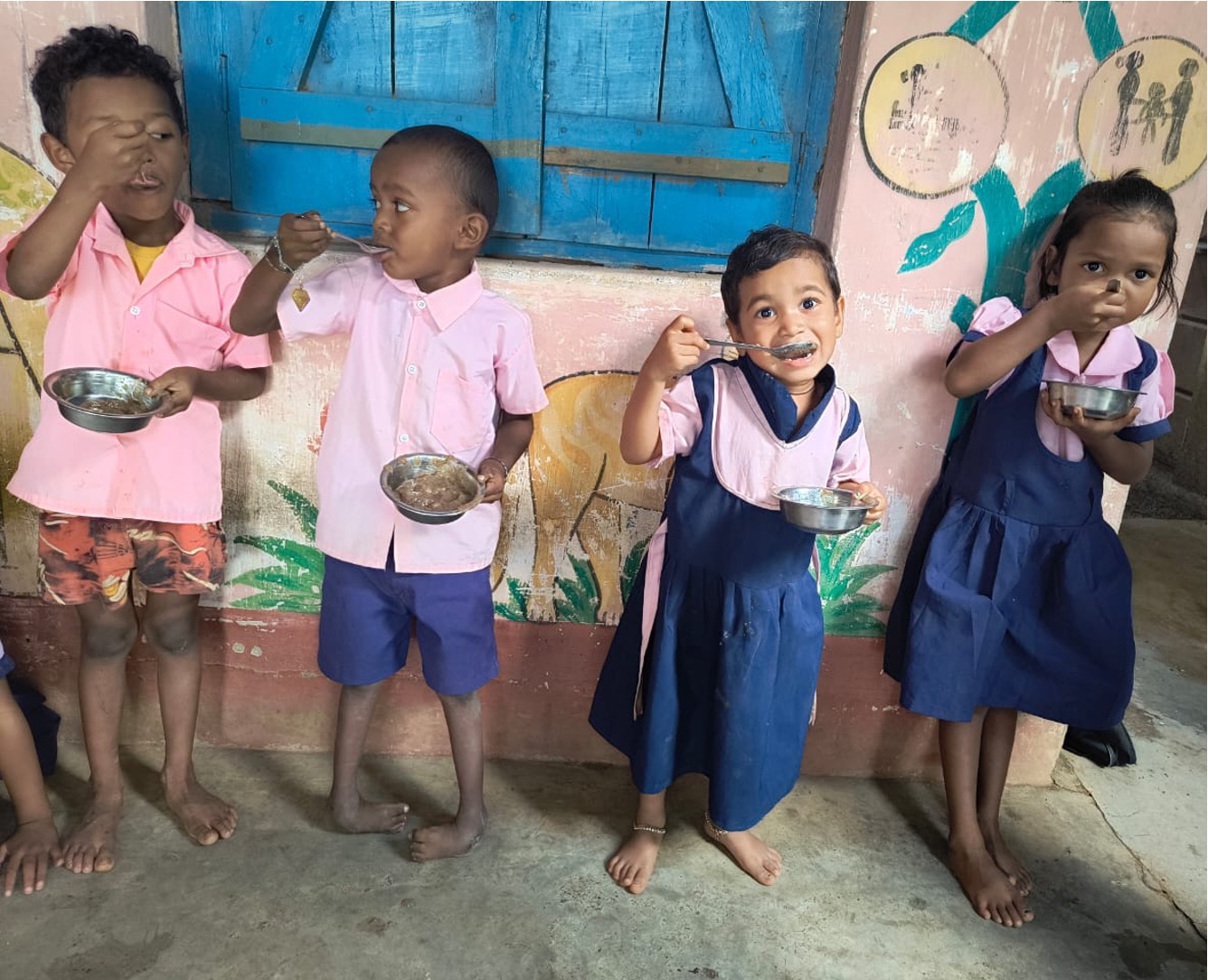
Malnutrition continues to be a significant health challenge among children in India, and is the primary contributing factor in over 50% of preventable deaths in children under five. The early years of a child’s life, particularly from ages 0-6, lay the foundation for lifelong health, which is why addressing childhood nutrition is a key pillar of S.N.E.H’s programming.
Not only do S.N.E.H’s Community Kitchens deliver meals to children, they also focus on supplying nutritionally adequate meals with proper calorie, protein, and iron requirements for optimal growth and development. To date, S.N.E.H. has provided over 6.7 million meals–and counting–to children in need.

Education
S.N.E.H’s education vertical takes on many forms. First, it strengthens Early Childhood Education, which, along with nutrition, is essential in laying the building blocks for a child’s cognitive, social, and emotional development. S.N.E.H supports Angwandi Workers by providing a framework for foundational learning that includes five core focus areas (cognitive development, physical and motor skills, language development, creativity and aesthetics, and social and emotional learning) and offers these young children a strong transition into formal schooling.
S.N.E.H’s education initiatives move beyond early childhood education and into the household and even the community at large. By organizing community gatherings, meetings with religious leaders, and conducting home visits, S.N.E.H. equips and trains frontline health workers to teach young mothers, parents, and adolescents about best practices for health, hygiene, and nutrition.
Health
S.N.E.H’s focus on building the capacity of frontline health workers is particularly important when it comes to Accredited Social Health Activists, or ASHAs, who are being trained on Infant and Young Child Feeding Practices (IYCF) and Integrated Management of Neonatal & Childhood Illnesses (IMNCI). IYCF focused on best feeding practices for infants and young children, including breastfeeding and the introduction of solid foods, which promote healthy growth, while IMNC aims to lower child mortality by addressing preventable yet common health issues, such as pneumonia and diarrhea in children under five.
To date, SNEH has assessed over 27,000 children for growth and nutrition, enabling timely care.
Community at the Centre of the S.N.E.H. Model of Sustainable Development
S.N.E.H.’s power and success lie in its localized, community-centric approach that is a model of sustainable development in India. The community meetings it conducts offer a space for caregivers to give real-time feedback to the S.N.E.H. program team on what solutions are working and what knowledge gaps still exist. The community meeting model also enables the program team to directly engage with state, district, block, and even village-level stakeholders, recognizing the power of grassroots support in mobilizing communities–and community-driven solutions–for lasting change. Additionally, this involvement fosters a sense of ownership, accountability, and investment that ultimately leads to better outcomes for the children, adolescents, and women being served.
Learn more about the S.N.E.H. approach to sustainable development in India by visiting the program page.
Sources:
- Black, R. E., S. S. Morris, and J. Bryce. 2003. “Where and Why Are 10 Million Children Dying Every Year?” Lancet 361, no. 9376: 2226–34.
- Caulfield, L. E., M. de Onis, M. Blössner, and R. E. Black. 2004. “Undernutrition as an Underlying Cause of Child Deaths Associated with Diarrhea, Pneumonia, Malaria, and Measles.” American Journal of Clinical Nutrition 80, no. 1: 193–98.


