As someone who does not identify as an athlete myself, my exposure to sporting events has almost always been in a spectator role. Growing up in the rural Midwest of the United States, it was often apparent to know a person’s allegiance to a specific sports team before knowing anything else about them. In high school, my Friday nights were spent in a sensory overload filled with cheerleaders, mascots, a marching band, and school spirit, while cheering on our all-male football team* alongside the rest of my town. Every sports team I know of has a rivalry and the object of any sports event is to beat the opposing team for no other reason than the glory of winning.
So, when I got the opportunity to attend the Ultimate Player’s Association of India’s 2022-2023 Championship Series Mixed National Tournament in Surat, Gujrat, I subconsciously anticipated a tournament that would be similar to my upbringing. To my pleasant surprise, the tournament was nothing like what I expected. Ultimate Frisbee, as I have previously written about, is a sport unlike any other I have come across due to its unique rules, value system, and approach. The tournament took place from Friday, February 24 2023 until Sunday, February 26, 2023 and featured over 400 players from 24 teams from across India. Since I am a frisbee novice, my observations and experience of the tournament were less focused on the matches itself and more geared toward experiencing the tournament through the lens of sociology: group dynamics, trends, behaviors, etc.

*I attempted to tryout for my school’s (American) football team in Middle School and was told it is a sport for boys only.
The Uniforms
Of course, the first observation I made at the tournament was about the clothing that people wore. From where I come from, sports uniforms are typically one or two “team colors” with a minimal design and each person’s jersey features their surname and their roster number (that typically corelates to their position on the field). At this tournament, the uniforms were anything but that.
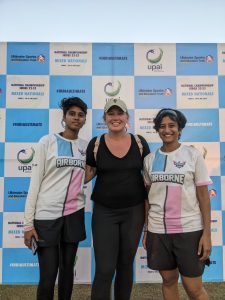
The jerseys were decorated, colorful, artistic, and many teams wore more than one jersey throughout the weekend! For instance, my home team from Chennai, Airborne, wore a striped white, pink, and blue jersey during their first match and then changed into a neon yellow jersey with a stingray on it for their second match. I learned quickly that even as a spectator, I had to be agile to keep up with this adaptive sport. My favorite jersey at the tournament was a galaxy themed flying meat kebab that was worn by Udta Kebab (“flying kebab”), a team from Project Khel in Lucknow. Another jersey I enjoyed was a pink and purple jersey that had “All the way to Willy Willy Wonka” written on the back of it worn by Stray Dogs in Sweaters team from New Delhi.
While the jersey designs were already a new experience for me, the names and numbers written on the jerseys were a whole other level! Before this tournament, any sports event I had ever attended had whole numbers between 0-99 written below the surname of a the player. But, this is Ultimate Frisbee, so bodily autonomy and freedom of expression is encouraged. Rather than uniformly feature player’s surnames, the jersey’s featured a WIDE range of names from first names to nicknames to last names to mixed names to made-up names. Some of my personal favorite names I saw were “Old Monk,” “Last Minute,” and “Rocket.” Similarly, the jersey numbers included 22.7, 100, infinity, and 0. Personally, I think the freedom of expression in the jerseys speaks volumes about what kind of sport Ultimate Frisbee is: come as you are and be free to be yourself.

The Spectators
In my limited sports experience, the fans and spectators typically outnumber the players and the sporting event is a source of entertainment for the onlookers. But, as you can guess, things operate slightly differently in the world of ultimate frisbee.
This tournament had five fields that took place in two outdoor locations: a farm and an Islamic community center. The average temperature was 35 degrees Celsius and the matches were played in direct sunlight without any form of shade. It was not exactly a spectator-friendly environment in the first place. But, given this was a National Championship, I anticipated a roaring crowd that was heavily invested in the outcome of the tournament. What I encountered, though, was a only a handful of individuals watching the games who were not players themselves (including myself). It seemed that if players were not actively participating in a game, they were either warming up with their teams, eating a meal, or strategizing with their team about their next game. Rarely did I notice individuals actively watching a game (other than the championship) from the sidelines.
Most of the time, I watched the matches alongside my coworker, Jyoti, and sat next to the commentators booth so I could understand better what was going on on the field. In a sport without referees, there are a lot of dynamics taking place on the field that are easy to miss without a subject matter expert. During one match, I watched alongside three Islamic burqa-wearing women who were passing through the community center and became curious about what was going on. In that moment, I thought about the various dynamics and layers of intersectionality of what this experience was: 400+ individuals who traveled up to 120+ hours by train to play a secular sport, sleep in a school, and have matches at an Islamic community center. Through my interactions, conversations and observations, I realized that these players are not playing for anyone’s entertainment, rather are playing for their own reasons.
The Rules
Despite not having officials to enforce the rules, ultimate frisbee has many rules and guidelines for the players to abide. Each match is played with two teams comprising of seven players on the field at any time. As a mixed-gender sport, the 4:3 gender ratio is maintained throughout the game and changes between men and women every two points. As an outsider, I noticed how diverse the teams seemed to be with men ages 50+, young women, and even children. This was a sight I had never seen in a sporting event before. Where many sports I have seen before have a standard body build, this tournament featured people of all physical shapes, sizes, and abilities. It was refreshing to be part of an environment that invites people from all ages, genders and physical abilities.
As a novice, I sat closely to the commentators to try to get insight as to what was happening in front of me. To the untrained eye, I was often wondering who the coaches were, why there were so many pauses in the game, and what strategies the teams were taking. Beyond describing the movement of the disc, the commentators discussed things like gender ratios, teams’ histories, and individual player’s backgrounds with the game. I was particularly intrigued with how often the topic of gender and spirit were discussed in the commentary.
Apart from the overall winners, the tournament also featured the spirit awards. To me, this was the most intriguing element of the entire tournament. Prior to the tournament, I understood Spirit of the Game to translate to “Which team cheered the most and was having the most fun?” But, I once again learned that is only one element of the concept.
After each match, the two teams would meet individually to discuss the opposing team’s gameplay and nominate a Most Spirited Player (MSP). In their meetings, teams discussed topics such as how well the other team knew the game rules and utilized them, if the team avoided fouls and body contact, how fair-minded the team was in their play (apologizing for mistakes, calling significant breaches), their attitude and self control (were they polite?), how well they communicated, and how gender inclusive the team was during the match. Afterwards, the two teams would sit in a circle (in an alternating team order), to discuss feedback for one another. The teams were then asked to rank each other from 1-5 in a variety of categories and self-rank their own spirit performance.

At the end of the weekend, three teams were awarded gold, silver and bronze medals for their team’s spirit. One of the spirit winners, Morning Star, is a recently formed team from Assam and this was their first tournament playing together. I appreciated that teams still had an opportunity to win and be recognized regardless of their tenure or experience.
The Game That Belongs To The Players
While I have attended many ultimate frisbee practice sessions, this was my first exposure to an official game or tournament. I have become well versed in the structure of a game, but had not previously witnessed the game in action. Ultimate frisbee is a self-refereed game, where the onus is put on the individual players to understand, respect, and enforce the rules. In the words of one player, “it is the one sport where players have to be strong physically, mentally, and emotionally to perform at their best.”
While some tournaments have specific age brackets, this particular tournament was open to people from any age groups. I already knew ultimate frisbee is an inclusive sport, but while I watched the matches, I could not help but be pleasantly surprised to witness this in action. Interacting with and observing the community on and off the field demonstrated their commitment to the values of the game.
While my presence at the tournament was merely to observe and spectate, I felt included and incorporated with the entire community. Even as an outsider, I was included and welcomed as part of the community. Overall, my experience at the tournament gave me a new perspective and lens to understand the power of sport, development, and community. I realized how powerful it can be to bring people together around a common interest or game.
References
All information was used with permission from the Ultimate Players Association of India and the World Flying Disc Federation.
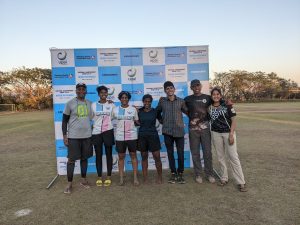
All photos were taken by the author with permission of the subjects.


