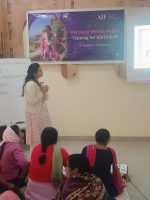
By Sophia Nesamoney, Ellie Kunwar, Pragya Anur, and Sahithi Pingali
Last summer, AIF piloted a new program for high schoolers geared towards learning service and fulfilling its vision to build a lasting bridge between the United States and India – the Youth Ambassador Program (AYAP). This summer, the second year of AYAP brought together 21 high school students – 14 students from the United States and 7 from India. AIF partnered with Santa Clara University’s Frugal Innovation Lab to guide participants through the design innovation process and prototype solutions. During AYAP we really tried to step out of the tourist mindset that a typical vacationer might have, and dive deep and immerse ourselves into the culture of India.
In the first week of AYAP – a three-week service learning and intercultural exchange in Bangalore – we observed how water is used in India. We started by visiting a flower market, where water is crucial for these farmers to grow their flowers, visiting schools to see how they are conserving and recycling their water, and visiting the communities of local students to see how they used water in their daily lives. We heard from inspiring panelists, like Rajesh Shah from Peer Water Exchange, who talked about how untreated sewage affects people everyday and not just rural communities. Meera K. from Citizen Matters, an online newsletter, encouraged us with her story about the transformation of a lake and how it just takes an idea and citizens who are willing to help to make a change.
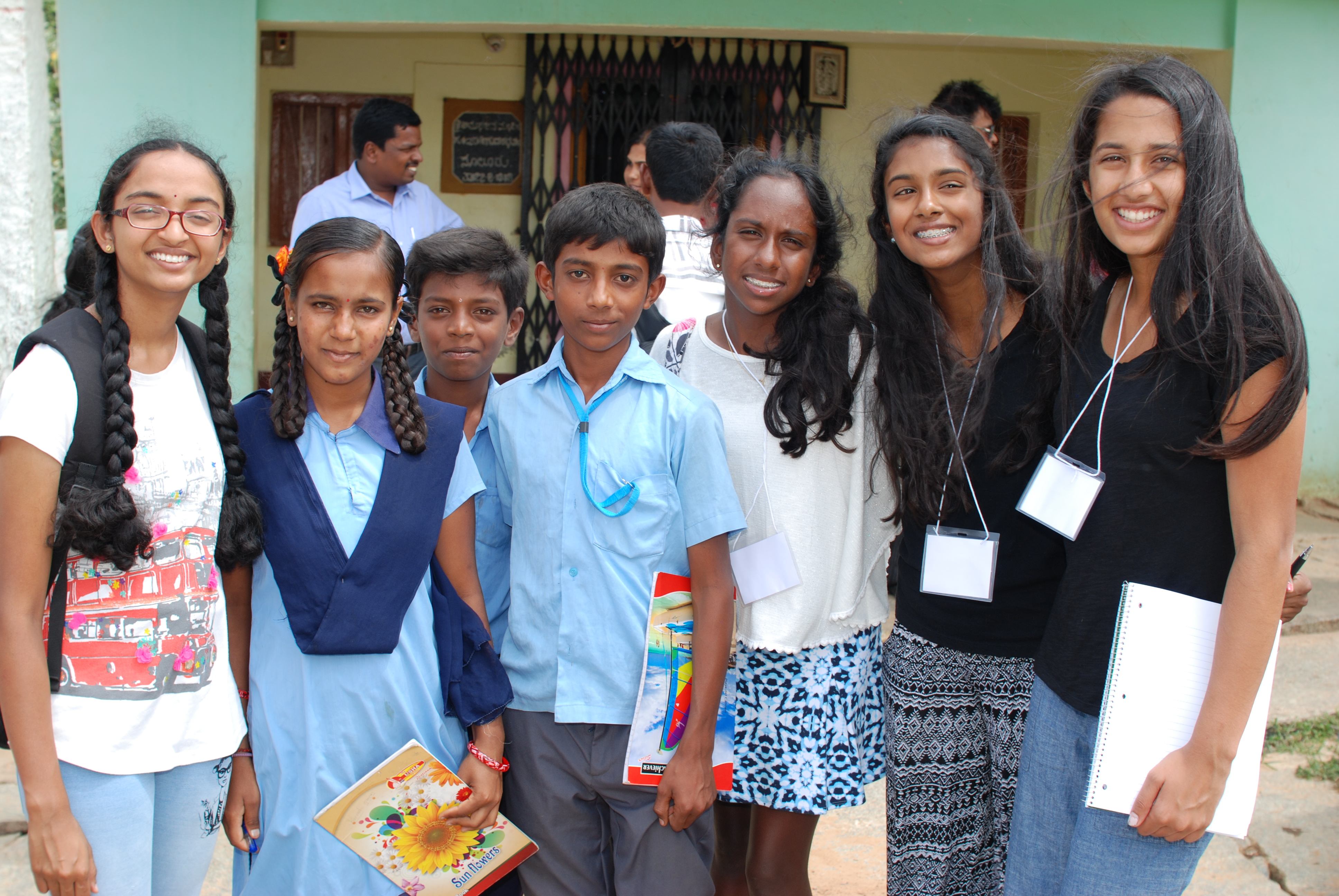 We were also shown the benefits of rainwater harvesting at Bangalore’s rainwater harvesting theme park. On a series of days, we enjoyed visits to AIF partner schools, Christel House and Suluru School. A school that runs on donations for students who come from some of the poorest communities in Bangalore, Christel House is one of the most advanced schools as 92% of graduates are in college, are working, or both. We worked with their high school students to create a mind-map of their current water crisis, from which we were able to derive a problem statement. We bonded with the students over games, food and drawings, then visited the communities in which they live. After truly visualizing and understanding their daily experience, we questioned our own lives and all the opportunities that we take for granted. Confronted with many hardships, which they faced head on with an open mind, the students were extremely hospitable and were open to answering all of our questions. This was extremely inspirational for our group, because being from families who are blessed with countless opportunities we often do not understand how fortunate we are. This eye-opening experience was seen throughout the trip in all the homes and schools that we visited.
The second school we visited was a government school, Suluru, located in the rural area of Bangalore. The students at this school did not speak English; however, through hand gestures and drawings we were able to learn more about their water situation and each other. By lunch we were playing duck duck goose with the students and teaching them the wave! We also visited the Suluru students’ village, where their water situation seemed better than the previous communities. Despite this, they were still faced with issues including no continuous access to clean water. At the house our group visited in this village, the family was exceptionally hospitable and offered us water, milk and insisted that we feel at home.
Throughout AYAP, we got the chance to work with students from Bangalore as well as students from across the US. We had the opportunity to collaborate with seven students from Inventure Academy in Bangalore, and shared new experiences with them including visiting local schools and being immersed in a newfound social and cultural scene. The most shocking part of the collaborative experience was that the students who lived in Bangalore were experiencing an entirely new outlook of their home city. This new perspective gave us all a frame of mind from which we were able to fully engage with the locals and students.
 AYAP taught us cultural sensitivity as well as global citizenship. In order to truly understand the lives of the local Bangalore citizens, we had to be fully aware of and respectful of our cultural differences and realize that despite our different backgrounds we could still easily relate. This cultural sensitivity allowed us to fully envelop ourselves in the service aspect of our trip as well as create bonds with the students and villagers. We were able to quickly gain perspective of their living and water situations, and use that knowledge to further explore and contribute to helping them.
Through the partnership with Santa Clara University’s Frugal Innovation Lab, we had a representative of SCU, Jess VanderGiessen, guiding and mentoring us as we learned about frugal innovation. Frugal innovation is the process of reducing the cost and complexity of a product to make it more effective for use in developing areas. We also learned about the design innovation process – a process used to truly understand a problem and then come up with a suitable solution for it.
Throughout the program, we were encouraged to look at situations and problems through the lens of this process. This made an enormous difference to how we looked at things; instead of passively observing the communities and schools we visited, the design innovation process made us strive to truly step into people’s shoes and try to really understand what they were facing. It encouraged us to look beyond the multitude of issues that were present and focus on the one true, central problem. We realized that simply looking at the right problem can play a huge role in coming up with an effective solution.
To gain some more experience in solving such problems, we did several workshops and activities. We learned the basic principles of frugal innovation, conducted a case study, and even physically built our own turbidity sensors. These activities gave us the knowledge and technical background we needed before we could start our final projects, in which we would each choose one issue and try to create our own innovative solution.
To inspire us and show us the types of innovative solutions professionals in the field were coming up with, we were taken to the rainwater harvesting park in Bangalore. At the park we saw a number of new and creative methods that were being used for rainwater harvesting in the city. Afterwards we also got the opportunity to meet one of the innovators who had worked on the various methods. Through these two experiences we were introduced to the kind of practical thinking that was actually taking place in the real world, and gained perspective on the way these problems should be approached.
After six days of visiting different communities and learning a wide variety of perspectives, as a group we decided to test different sources of water to see what was really in it. With a little help from Usha Nesamoney, one of the co-chairs of the AYAP program, we tested 12 different sources of water from different communities in India. Some of the sources included a borewell, a government tank, two different tankers, and an underground storage from the Suluru school. After testing the water for nine different possible contaminants, we found that the least pure sources were from the borewell in one of the poorer communities, and the water from the ganesh tanker. After finding very similar results from these two sources we inferred that the ganesh tanker could be from a borewell, similar to the one we tested.
The results of the water quality testing got us thinking about which contaminants were truly the most harmful. At first, we chose to focus on hardness, bacteria, and heavy metals that were in the water. After doing research on each of these main problems, we found that hardness had little to no effect on the health of the person drinking that water. The only effect it had was on the material it was used to clean. For example, when the hard water was used to wash clothes, the clothes would get ruined. Once realizing the real problems were the heavy metals and the bacteria, we knew our frugal innovation would have to focus on mainly filtering these out.
When we started looking into other solutions that are already successful in filtering out heavy metals and bacteria, it seemed most of them had a common problem: they were very expensive processes. No matter the reasoning behind the cost, whether it wasted resources or was just not accessible enough, we realized that our product was going to be more difficult to create than we originally thought. One of the best working solutions being used in India today is the process of reverse osmosis (RO). This process is very effective in removing the heavy metals and the harmful bacteria. On account that there is a lot of water wasted in the process and the equipment is expensive, the government has provided one RO plant for every fourteen villages. Another possible solution for removing heavy metal was using animal bone char as a filter. The main issue to this was that the animal bones would only burn to char at a very high temperature, and the ovens that have the capabilities to do this are not commonly found in the rural areas.
The focus of the AYAP program, this year and last year, was water. Water was chosen as a central topic because it is a resource that transcends the boundaries of countries and classes. The worldwide shortage of water and problems with water purity affect everyone in the world.
We looked at water in a wide variety of contexts. One of the first aspects we looked at was water quality. Contaminated water can have terrible negative impacts on a person’s life. Drinking impure water can directly impact a person’s health, and through this hinder their learning and work. When we visited the slums near Christel house, we spoke to a family who told us that they drank government water without boiling or filtering it, since filters were too expensive and boiling water produced too much smoke.