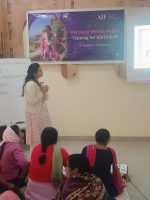
My first visit to the field was almost a week after my relocation to Jamshedpur. During that one week, I had studied quite a bit about the program that I will be working on, the cultures I will be interacting with, and the languages they speak. I tried to familiarize myself with the beneficiaries as much as I could and yet that was not enough. Now in hindsight I realize that it would never be enough and that is where its beauty lies.
Contrasts between Bistupur and Kuchai
The week prior to this visit, I stayed in Bistupur, the bustling epicenter of Jamshedpur. It housed some of the city’s most famous shops and restaurants. Surprisingly, in that entire week I hardly saw any women on the roads. This was quite strange for me; everyday I would step out hoping to see someone my age, but not a single woman crossed my path during that time. The lack of visibility was unsettling, and it lingered in my mind as I prepared for my field visit.
A week later, as we climbed through the surreal mountains of Kuchai, the scenery kept vacillating between the warmth of the lush green bushes and the coldness of the woods. Amongst these changing sceneries, the extraordinary strength of women became a permanent reality. From the glass windows of my car I could see young girls riding their bikes to school, young women carrying water back home, women working in the fields. This was a stark contrast to my time in Bistupur.
Daily Life and Gender Dynamics
This made me think. Where are the men? What do they do during the day? Upon probing a little bit, I gathered that some men were out of the village and migrated to the cities in search of work and the rest were at home. In this region, during the sowing season both men and women work in the fields but during the reaping season, men are often found intoxicated with mahua (a local beer) while the women tire themselves out in the field.
Even during their pregnancy, women rise before dawn, diligently clean their homes, work relentlessly in the fields, and return home at the end of the day to prepare meals for their families – continuing this routine up until the last day of their pregnancy.
Economic Empowerment vs Societal Norms
Several articles and research papers posit that expanding women’s’ employment opportunities will result in empowerment of women (World Bank 2012, Heath and Jayachandran 2018). Moreover, Economic theory postulates that as the opportunities to earn an income for a woman increases, her control in the household should increase as well (Browning and Chiappori, 1998). Does this mean that the women from this part of Jharkhand get to be the decision makers of their house? Unfortunately, the answer is no. Instead, societal norms and deeply ingrained gender roles dictate who holds that power. Through their lives, I learned that empowerment is not as objective as it seems , it is riddled with unwarranted factors like gender roles, which often outweigh all other objective determinants of empowerment.
Closing Reflections
As I reflect on my time in Kuchai, I am struck by the strength and resolve of these women, juxtaposed against the stark realities of their lives. Their narrative compels us to rethink what empowerment truly signifies. Is it possible for economic opportunities to translate to real agency ?
References :
World Bank (2012), ‘World Development Report 2012: Gender Equality and Development’, World Bank.
Heath, R and S Jayachandran (2018), ‘The Causes and Consequences of Increased Female Education and Labor Force Participation in Developing Countries”, In SL Averett, LM Argys and SD Hoffman (eds.), The Oxford Handbook of Women and the Economy. Oxford University Press, New York.
Browning, Martin and Pierre-Andre Chiappori (1998), “Efficient Intra-Household Allocations: A General Characterization and Empirical Tests”, Econometrica, 66(6): 1241-1278.


(Picture from Kuchai. Credits : Author) (Picture of the beneficiaries. Credits: Author )