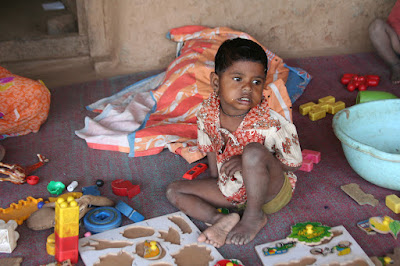
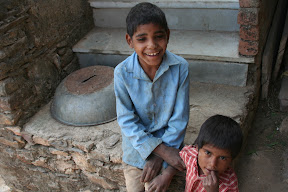
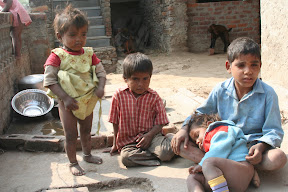
He sat on the outskirts of the group looking forlorn and listless. His dejection was palpable; the buoyant, world-is-my-oyster innocence of childhood had been robbed from him without remorse. Already, the Anganwadi Centers* relevance and need in the community was painfully self-evident. Too bad this system is better at feeding goats than it is children.
 |
| From Ladoos and Balsaki Day Care |
Recently, Dr. Sharad, ARTH’s Executive Director, told me a story that demonstrates one facet of why malnutrition continues to be a national scourge, causing almost half the children under age five to be underweight.
A couple years ago, Dr. Sharad met one of the manufacturers of the Take Home Ration offered for free to pregnant and lactating women and children under three through the Anganwadi Center (as stipulated by the national government’s Integrated Child Development Services Program). This gentleman told him that his company had won the manufacturing bid because of their “cost-effective” recipe, which was a mixture of wheat and groundnut flour, oil, and sugar. Realizing that Cerelac was 10 times as expensive, Dr. Sharad asked him if he could buy a packet for his son, whom at that time was about 2 years old. Sheepishly, the man said that Dr. Sharad shouldn’t buy it because his son wouldn’t like it. Dr. Sharad pressed further, saying that two year olds are two year olds and if rural children were eating it then why would his son be any different? The man explained that during the bidding process, they had to cut out the most expensive elements, i.e. sugar, groundnut flour, and oil, so he admitted that he didn’t think anyone was actually eating it…
WHAT?!
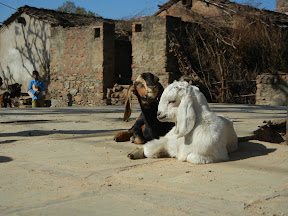
You’re probably thinking that the quality must have changed over the past couple of years? I guess you could say that the quality has improved if you are taking a goat’s perspective. I’ve learned that the ration is often fed to goats, which must be a nice change to the dry shrubbery available during the winter months.
 |
| From Reproductive Anatomy Session |
Call me tactless, but I need to use a little tongue and cheek to process the total disregard for human life in favor of blatant personal gain. Cynicism aside, the Anganwadi system is a platform that can be leveraged to address the endemic problem of undernutrition. I am not questioning the integrity of the Anganwadi Workers, many of whom I have seen demonstrating warmth and consideration for the children that goes above and beyond the mechanical requirements of their job. Instead, I am trying to understand how to tackle the myriad gaps – negligent supply chain management, poor staff training, policy makers with personal agenda – in the public health system. Here are some examples:
The hidden disease
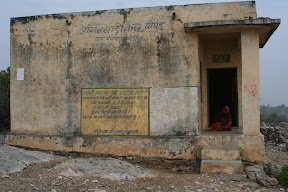
Recently, I accompanied a team from the international NGO, Action Contra La Faime, to survey the nutritional status of under fives in a couple of villages in ARTH’s field area. We visited the Anganwadi Center
 |
| From Cooking Test |
(Anganwadi Center)
 |
| From Cooking Test |
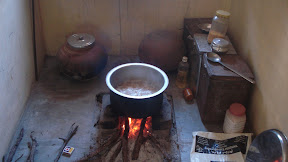
(rice/dal being prepared by Anganwadi Helper) and asked the Anganwadi Helper to explain how she determines which children are malnourished and therefore should receive the extra packet of the goat feed… ahem, take home ration… or be referred to the malnutrition treatment center (30 km away). She gave us a blank stare and said she didn’t understand “malnutrition.” We were confused because one of ARTH’s studies revealed that 44% of children are malnourished in its field area. The cruel irony is that because malnutrition has become so ubiquitous it has desensitized the very people who are positioned to do something about it. She did show us a tool that the ASHAs (government front-line health workers) use to monitor children’s growth. However, ASHAs are paid for the completion of these charts, not for the number of children they refer and recover, so there is no incentive for this tool to translate into appropriate action. Furthermore – and in my opinion most tragically – community members themselves do not advocate for improved child nutrition services despite acknowledging that they think their children are weaker than those in neighboring villages and much weaker than those in Udaipur.
 |
| From Biferi Village |
 |
| From Biferi Village |
Absenteeism
When we visited the malnutrition treatment center not a soul was to be found. And I don’t mean that it was functioning properly but there were no kids to treat. No, the place was completely desolate; another shining example of absenteeism in the public health system. So, even if the Anganwadi Helper identified and referred a malnourished child, there would be no one to provide any treatment!
Religious Influence
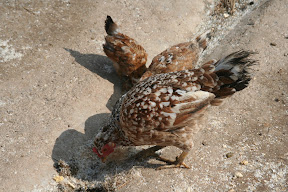
Policy makers in the current Rajasthan Government administration have been debating the utility of incorporating eggs into the ICDS’ supplementary feeding program. They have been opposed for religious reasons, citing that similar nutrition is available from vegetarian sources. Although this may be true, other vegetarian sources such as dal and other legumes are expensive and dependent on growing cycles. Inclusion of eggs is sensible on many counts: they are cheap, readily accessible, simple to cook, and there are fewer chances of corruption. But, because the Brahmin caste (highest caste) is vegetarian, there is a bias against non-vegetarian diets; for example, my colleague had to conceal her husband’s love for meat when they were trying to find an apartment because many landlords won’t rent to those with carnivorous predilections. Eating meat has become a counter-culture statement which some of the more progressive city dwellers are now championing to demonstrate anti-castism. Regardless of its political connotation, eating meat is a way of life and privilege for a large proportion of the populations where ARTH works. I have seen chickens in all of the villages where we conduct our group meetings, so it is shameful that the statewide policy has adopted this castist position instead of looking at the habits of the very people who need its services the most.
 |
| From Biferi Village |
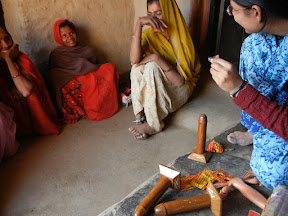
Now you can see why tongue and cheek humor is a necessary coping mechanism for dealing with the daunting challenges at each level – supply, service provision, demand, policy. Fortunately, India is a democracy at heart and thus has mechanisms that are – or can be – responsive to people’s needs. In my opinion, the focus needs to be at the grassroots level: educating women about their rights, and most importantly, enabling them to find value in asserting themselves. Many of the young women we meet through our group meetings either aren’t aware of the Anganwadi, don’t use its services, or don’t complain when the services are unacceptable. Despite its own quirks, the US’ democracy has made me acutely aware of – and proactive about obtaining – my entitlements without even knowing it. I mean, I even complain when I don’t get the free toothbrush from my dental cleaning checkups and I’m sure I didn’t learn to do that in my 8th grade US History class. Coming from this background, it is painful to hear women acknowledging the lesser health of their children without demanding attention. A democratic government should reflect and be responsive to its people, but without guidance from the grassroots, lethargy and profiteering easily mar decision-making at the top-level. Despite all the gaps in its operations, I have not lost faith in the Indian government chiefly because I have not lost faith in its people. The women we are working with know what is best for them and their families, but have not had the opportunity to develop expectations for and skills to negotiate change. I am optimistic that the knowledge gained – whether that includes information about the Anganwadi center or how to put on a condom
 |
| From Reproductive Anatomy Session |
– and confidence built – such as changing a light bulb, reading a calendar, or signing their name – through our group meetings will enable women to become better advocates for themselves and their families… instead of for goats.
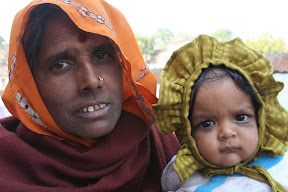 |
| From Biferi Village |
*The Anganwadi Center is the village level point of contact for the national level Integrated Child Development Services Program. One of its primary objectives is to reduce malnutrition among adolescent women, pregnant and lactating women, and children under six. The team of an Anganwadi Worker and Anganwadi Helper are responsible for cooking a free breakfast and lunch and providing take home rations of fortified mixed flour for this cohort.


