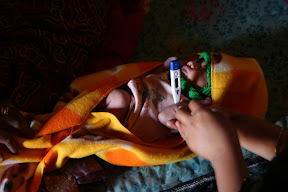
The baby started to squirm in his polar fleece blanket, unhappy that an intruder had exposed its butt to the cold December air.
 |
| From Chapra Field Visit 11/30/10 |
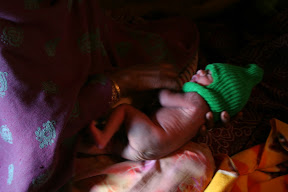
The intruder was one of ARTH’s nurse-midwives, Mangu-ji, whom I had accompanied on her round of village-level home visits to women who had delivered within the past week. It was lucky that Mangu-ji was giving such a close examination, because she discovered that the baby’s left thigh was dark blue and had a small cut.
 |
| From Chapra Field Visit 11/30/10 |
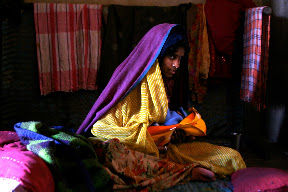
Mangu-ji asked the mother if she had seen the discoloration and taken the baby to the health clinic. The mother, a tiny, fragile-looking 19-year old woman, sat listlessly and remained mute. I was told that women in this area are supposed to remain indoors, untouched by anyone, and interact only with close female relatives for 2-4 weeks after delivery. I’m sure this is a valuable protective measure from their normal work and domestic responsibilities, but the irony is that, based on my limited observations, some of these women seem to be depressed, which is linked to poor infant care and malnutrition.
 |
| From Chapra Field Visit 11/30/10 |
However, the real kicker for me was her mother-in-law’s answer: she explained that the baby was perfectly fine; he was reincarnated from a woman who had the same discoloration, so there was no reason for them to seek health services.
Over the past three months, I have been repeatedly shocked and amazed by the impact of local superstitions, cultural norms, and belief systems on health outcomes. In designing the life skills curriculum for the Young Married Women’s Reproductive Health and Empowerment Program, I have been investigating local attitudes and practices to inform the topics and messages that we include in the group education sessions. This has been a truly staggering experience, and has called into question my understanding of how to deliver community-based preventative and curative health services.
Lesson 1: Logic cuts both ways.
Recently, we tested a series of sessions I had designed on appropriate infant and young child feeding practices (I have learned more about breastfeeding than I ever thought possible, like, for instance, a nipple as 15-20 holes which expel milk. Just a bit of trivia.). It is estimated that initiating breastfeeding within the first hour than continuing to exclusively breastfeed for the first six months can reduce up to 20% of infant deaths; obviously this would have a major impact in India where 1 million infants die each year. When we began discussing the importance of early and exclusive breast feeding, which benefits both the mother (reduces risk of postpartum hemorrhage, causes uterus to contract to pre-pregnancy shape, bonding with baby) and child (collostrum is rich in nutrients and antibodies, and bonding with mother), we learned that many women either do not feed their child for three days post delivery, or give water or other forms of milk, which are likely to cause diarrhea. Apparently, there is a common belief that breast milk has been sitting in the breast for the duration of pregnancy, so the milk that comes out during the first couple of days is spoiled and harmful for the baby. This is a completely understandable rationalization since collostrum, the milk that is expelled during the first week, is typically more yellow and stickier because of the higher concentration of vitamins, minerals, antibodies, and other health-promoting components. So, we acknowledged that their observation was correct – collostrum does look different – but reframed the “difference” so that it was presented as beneficial. But, without anything tangible and immediate to prove this fact, I’m unsure (at best) whether they will change their behavior. In the US, we’ve become so dependent on and receptive to experts that we’ll believe most anything they advise (for better and for worse). With illiteracy rates as high as 60%, however, the predominantly tribal and scheduled caste populations do not have exposure to “modern” information (i.e. can’t read clocks), and therefore remain skeptical of ARTH’s intentions even though we’ve been working in the area for over ten years.
Lesson 2: Incorporate local beliefs.
Another misconception about breastfeeding is that special foods like ladoo, a sweet made of ghee, sugar, and flour, promote breast milk production. This custom is not inherently harmful, and in fact is probably beneficial because women eat more calorie-dense food. However, without understanding that suckling stimulates breast milk generation, the mother may become fed up with eating ladoos and not seeing any change, and thus stop breastfeeding altogether or at least insufficiently for her baby’s growth — perpetuating the intergenerational cycle of malnutrition. At first, I thought to myself that these women should learn the correct physiological process for their own good and their future child’s benefit. I felt like they had a right to know the science-based explanation and it would be a small way to reconcile them being deprived of attending school. However, I realize that my rights-based American upbringing was getting in that way of what was ultimately important: to use it as an opportunity to demonstrate that we were not there to reject their indigenous customs, but instead to expand their knowledge base with complementary health-promoting practices. Establishing a sense of partnership in addressing their health needs is crucial to getting women to open up about their beliefs and practices and listen to alternatives. If we come in as the experts with an authoritative tone, it will be our kiss of death.
Lesson 3: Nothing succeeds like success.
Because women are overburdened with housework, fieldwork, and family responsibilities, they have not been habituated to spend time teaching their child to eat as they transition from breast milk to semi-solid food after 6 months. Think about how much effort it takes to feed a toddler. They’re constantly spitting up the food, using it as ammo for the unlucky passersby, or just aren’t interested. Poor encouragement from the person responsible for feeding, which in India is the mother, mother-in-law or older sibling, is one contributing factor to the high prevalence of stunting and wasting in young children. Sadly, India is home to 1 out of ever 3 malnourished children in the world. This is particularly worrisome because malnutrition is linked to half of childhood death and nearly a quarter of cases of disease. These statistics have become painfully real to be over the past three months. I’m not trying to sensationalize malnutrition; instead give the backdrop to why we are trying so hard to figure out ways to communicate with women about how they feed and care for their children. With all of this in mind, I designed a session on proper feeding practices between 6 months to 2 years, a window when irreversible damage to a child’s physical and mental development occurs.
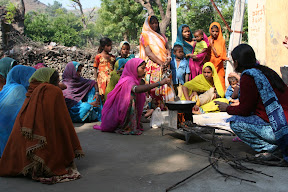
Part of the session included a cooking demonstration to teach women a nutritious, easy to make, and cheap dish made from locally available ingredients that they can give to their children at 6 months when they require additional calories to what is provided through breast milk. Typically, children at this age are given Parle-G glucose biscuits, cheap (4 rps for a pack of 11), easily available, but worthless in the nutrition arena, and chai, which interferes with the absorption of what little iron is in the biscuits.
 |
| From Cooking Test |
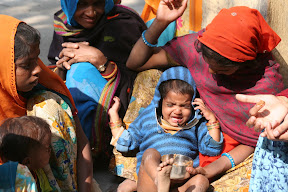
After the fortified flour roasted and cooled, we helped each mother mix it with sugar and milk to make a paste. Instead of making one big dish and distributing portions, we wanted each mother to make an individual helping so that they could emulate the process at home. Initially, when the first mother tried to feed the paste to her little boy, he recoiled and cried, not wanting anything to do with the unfamiliar brown substance.
 |
| From Cooking Test |
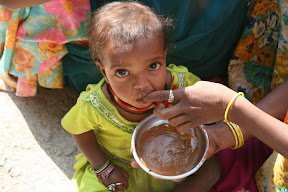
We took this as an opportunity to encourage the mother to persist, and reinforced the message that young children need to be taught how to eat, similarly to how they need supervision as they learn to walk. We linked it to disease prevention so that they understood the context and direct benefit for their child and themselves, since they wouldn’t have to spend money and time caring for a sick kid. The mothers obliged, and slowly the children began gobbling up what their mother gave them on a spoon and soon started to dip their fingers into the bowl themselves. My heart leapt!
 |
| From Cooking Test |
Knowing the complexity of changing culinary practices, it was encouraging to learn that several of the women have made the recipe for their children since the demonstration.
I become confused, paranoid, and exasperated when thinking about some of these inveterate cultural practices and beliefs, unsure to what extent they can and should be adapted. Part of me feels uncomfortable treading on the cultural turf, wanting to avoid cultural imperialism but also acknowledging that it is equally as bad, not to mention condescending and foolish, to think that cultures are stagnant monoliths. Yes, I want to rip my hair out when I see new moms trapped inside a dark room, not able to exercise choice about their mobility or think objectively about the danger signs to their newborn’s health. But, just because I wouldn’t like to be stuck inside a room doesn’t mean that they feel the same way, and it is probably serving some beneficial purpose that I can’t appreciate. BUT, rationalizing an obvious health complication as a factor of rebirth cannot be ignored. So, the challenge for me is to figure out how to simultaneously honor local beliefs and practices yet distill and address the ones that cause harmful outcomes, and deliver information that is empirical yet respects their existing rationale. It is uplifting for me to see small changes already happening in one community – new recipes incorporated into family meals -, and on my end – not impulsively contradicting a practice like eating ladoos. This two way process of listening, compromising, and adapting has ultimately given me the biggest take home lesson: communication and trust can trump a medical degree or specialization in addressing community health.


