Throughout the course of my work in India, I have had the opportunity to meet with many small business owners, from industrialists, to shop keepers, to hoteliers. In these meetings, I always tried to understand what the employers hiring needs were and how people with disabilities could bring value to these private sector companies. Perhaps the most in demand skills were computer skills. This is not to say that the companies were asking for computer engineers. Instead, they were searching for people who might be able to take bookings online, read and respond to emails, and other skills of that nature. However, when I met with candidates, I realized that these skills were functionally nonexistent with many candidates.
Internet access in India is far from universal in both urban and rural settings. However, in rural India this is particularly acute. According to a joint report form the British market intelligence firm Kantar and the Internet and Mobile Associate of India, only thirty one percent of Indians living in rural communities had access to the internet. Additionally, the report states that “Mobile phone remains the most used device for accessing internet with almost 100 percent of the active internet users opting for mobile phones to access the internet.” Thus, while internet access has improved and peoples familiarity with the World Wide Web has increased their understanding of how to use a computer has not. If you were someone who was taught to type as a child it is easy to forget that it is a difficult skill to master. Additionally much of the information online dedicated to learning about computers is in either Hindi or English making it difficult to learn. Furthermore using a computer can often require a basic knowledge of English that many people lack. The effect of this is that there is a huge gap between the skills that employers are looking for and that of which employees are equipped with.
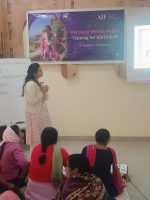
So, when I heard that the Minu School at Rajasthan Mahila Kalyan Mandal had opened an inaugural computer lab – I was intrigued. I sat down with Ishwa Sharma the principal of the Minu School to discuss the project and how he sees the role of computer education going forward. The interview was long so I have attempted to summarize the key points in the following sections.
Mr. Sharma explained that technological illiteracy was no longer a viable option in todays world. In fact, technological literacy is beyond a life skill but more broadly a human right. To deny children with disabilities the chance to learn about computers is to deny them their human rights. He drew parallels between refusing to teach a child to learn to read and write. But Mr. Sharma also explained that there was value in tech education beyond simply knowing how to navigate the world. He explained that the computers serve as a vehicle for teaching nondisabled children to behave with empathy and care, as they work to support their disabled classmates in the computer lab. Mr. Sharma explained that someone might use the mouse for a child who has a locomotor disorder. Mr. Sharma also explained that by building computer competency in children with disabilities that RMKM is working directly to dispel negative stereotypes about the innate abilities of disabled children. Later in the conversation, he explained that RMKM is on the forefront of offering digital education to children with disabilities, stating that only very recently had computers started to become available in schools for children with disabilities. It was interesting to see the overlap between primary school education and the sort of life skills I look for when placing candidates. In the disability employment space, we often look at pre-vocational education as a separate entity so seeing how these life skills were incorporated into the larger educational infrastructure was fascinating.
As always I am so humbled and impressed by the people that I met at Rajasthan Mahila Kalyan Mandal and I thank the American India Foundation for supporting me in this Fellowship.