A Journey to Khamir
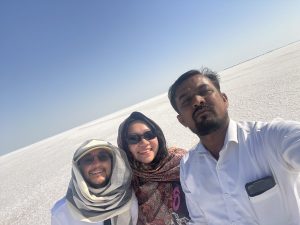
In the first week of April, I had a unique opportunity to visit Khamir and stay on their campus thanks to a professional development grant from the American India Foundation. Khamir, an NGO based in Gujarat’s Kachchh region promotes local artisans and their crafts through its platform. What began as an effort to see how Khamir connects rural artisans to markets, evolved into a journey of discovering the rich crafts and traditions of Kachchh, deeply shaped by centuries of migration routes across South Asia and West Asia. “Khamir” in the Kachchhi language means “intrinsic pride” and is also the Hindi/Urdu word for “yeast” and the process of fermentation. In that, I found it very fitting because Khamir’s campus is designed with the thought of sharing and developing ideas, a fermentation process of deep knowledge and experience of the artisans that transform mere cloths to vibrant canvases and give threads a new way of life.
As a Banyan Impact fellow working with ECOWRAP and its Bhayli Project, a livelihood initiative focused on empowering rural women through opportunities in up-cycling, I was first interested in Khamir due to its Recycled Plastic Weaving Project. My main goals for the visit were to learn about the plastic weaving process in Kachchh, analyze Khamir’s strategy in marketing its products made from plastic, and see how the organization was bridging the gap between rural artisans and the market. Early April in Kachchh had already brought immense heat with temperatures soaring past 40°C (104°F) and the occasional gentle breeze provided little relief. The 15-hour train ride from Jaipur with little sleep had worn me out, and I hoped to get some rest. However, as soon as I arrived at Khamir’s campus I was greeted with the sounds of birds, of tinkering of metals, and the occasional rush of water. I at once began to explore my surroundings and the workshops featuring the different crafts from Kachchh.
Mansukhbhai (Bela Print)
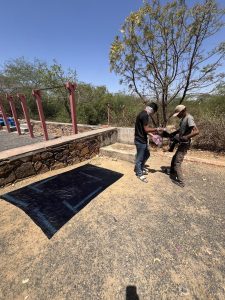
My time at Khamir was made most memorable by Mansukhbhai, a Hindu printer from the Khatri community. The Khatris are believed to have migrated from Sindh, in present day Pakistan to Kachchh around 400 years ago. Mansukhbhai is a tall, thin man who moves about his business, nonchalantly laying out the beige cloth in front of him. A simple man of few words, the daringness comes out as he dips his wooden block into a dye bath and onto the fabric — an absolute precise stamp of the motif on the cloth. Entranced by the precision of his stamping, I started a conversation with Mansukhbhai about the Bela printing process and quickly learned that he is the last Hand Block Printer of Bela. The last holder of its knowledge.
Bela Print is distinct in its iconic red and black colors, the first achieved by using natural, vegetable dyes and the latter achieved by a process involving mud paste and iron rust. Mansukhbhai’s hometown of Bela was once well-known for having a large concentration of block printers, however, as rivers started drying up and machines produced cheaper goods, many artisans looked for livelihoods elsewhere. Only Mansukhbhai remained, undeterred, eventually leading him to Khamir, which provided him the space and facilities to continue his craft while sharing his knowledge. As I sat listening to Mansukhbhai’s story and watching his methodical process, I was enthralled by both the precision and creativity needed for his craft and struck by the slow, timely process of a fading tradition.
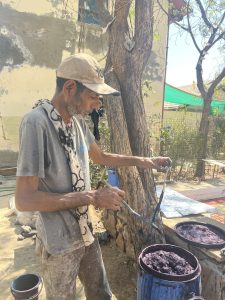
As Mansukhbhai moves to an open space, I follow his path observing each step of his hand. At the moment, he is mixing a few ingredients together. I inquire about the ingredients and write them down on my notepad. Water, lime powder, caustic soda, indigo…Indigo?! While indigo is not traditionally used in Bela print, Mansukhbhai explains that it caters to modern preferences and he himself has relearned the dyeing process with new indigo designs. I ponder gazing at the 60-year-old man in front of me as he dips a piece of cloth into the mixture to test the strength of the color. I am moved at the grit and resilience of this man to continue Bela’s tradition despite the struggles and the roadblocks. A light breeze, the sounds of chirping birds bring me from my thoughts to finally ask him the question I had been meaning to all day. “Will you be the last Bela printer?” Mansukhbhai looks up from his work and with sad eyes replies, “I think so.” He explains that young people do not want to do this work as it requires a lot of time and effort. He expresses his sorrow that Bela’s younger generation may never come to know the rich heritage and culture of this art. However, there still seems to be a glimmer of hope in those sad eyes. Mansukhbhai’s son, Mehul has recently started learning the art from his father in hopes to continue the tradition of Bela. Textile labels have also started taking notice of the importance of Bela as a fading, cultural heritage of Kachchh that needs preserving. By working with Khamir and Mansukhbhai they have helped in reintroducing Bela through new designs that are adapted for modern preferences. Through it all, Mansukhbhai remains hopeful for the future of Bela. As his lanky form moves to dry a piece of cloth on the line, I send a quiet prayer. May his craft always endure, and the stories carry on in the hearts of the next generation from Bela.
Paresh Mangaliya (Khamir)
As I explored Khamir’s campus looking around the many workshops and seeing artisans at their craft, I came across the main office. I decided to peek a head in as this was a good opportunity for me to speak to Khamir’s marketing lead. Lo and behold, the first person I ran into was Paresh Mangaliya, Khamir’s Business Head. Pareshbhai, as he is lovingly known on the campus, is a man in his early fifties, with a kind face and a ready smile. He greets me with enthusiasm and asks me the reason for my visit. This starts our one-and-a-half-hour unplanned interview where I get a glimpse into the critical work of an NGO that is linking rural artisans to the market in a largely unorganized handicraft sector.
One large challenge that rural artisans in the Indian handicraft sector face is a lack of market linkages. With limited direct links to buyers which is exacerbated by an already fragmented value chain makes it incredibly challenging for artisans to sustain their livelihoods. Compounding this are limited digital literacy and financial constraints which prevents artisans from leveraging online platforms to connect directly with urban buyers and wholesalers. Therefore, my intended goal was to discover how Khamir is bridging connections between its artisans and the handicraft market. I soon found out from Paresh Ji that Khamir does this through three ways— the wholesale market, e-commerce, and exhibitions.

The first way in which Khamir links its artisan community to a wider market, which also accounts for 80% of its business activity is its wholesale market. With clients in megacities like Delhi and Mumbai, who in turn sell Kachchi handicrafts to their local markets, Khamir ensures that its products reach a broader and more diverse base. It serves as an intermediary between the buyer and the artisan by ensuring that artisans are working on time and are sticking to designs according to the buyer’s wishes. When I asked Paresh Ji about Khamir’s involvement in the international export market, he remarked that only 5 to 7% of their business activity accounted for international shipments and they were reserved for those with long-term partnerships. In total, including both the Indian and the international market, Khamir has around 25 long time buyers and solid partnerships. In this role, Khamir engages on behalf of the artisan by organizing all the packaging and preparing all the necessary documents needed for shipment. When asked about what has made Khamir so successful, Paresh Ji emphasized the importance of trust-building and transparency. “You had to build that reputation over time,” he said. “It was not only about the quality of the product itself, but also the openness; you have to show everything about the supply chain and be as transparent as possible to attract your audience.” According to him, Khamir’s credibility has been shaped not just by beautiful craft, but by its willingness to share the story behind each product, from raw material sourcing to artisan involvement. This openness, combined with long-term community engagement and a commitment to fair practices, has helped Khamir earn both local trust and global recognition.

The second way that Khamir connects its artisans to the market is through e-commerce, which was initially started during Covid. Khamir’s online shop features collections of various handloom fabrics and block prints, as well as decor items such as Harappan pottery, copper bells, and lacquer-turned wood spoons. Through their instagram account, they have marketed their brand in an efficient manner that highlights their role in the preservation of the cultural ecology of Kachchh. Through their visually engaging reels of the craft process to the empowering personal narratives of their artisans, Khamir has successfully added a wider base of consumers who appreciate local handicrafts. The organization also has a physical craft shop at the campus that displays all 12 crafts that Khamir works with. Guests staying on the campus, which is always full during the winter months can learn about the different crafts, interact with artisans, and buy products directly from the shop.
Lastly, Khamir features one large exhibition a year and showcases the work of certain artisans and Kachchhi art/craft forms. This exhibition displays interactive craft workshops led by the artisans and films that highlight their personal stories and processes of the art form itself. It also brings together governmental organizations, NGOs, designers, artists, and craft lovers from all over India and the world to Khamir’s campus. This is an opportunity to buy the many different craft pieces on display that feature the rich and ancient Kachchhi craft traditions. Throughout the year, Khamir’s also takes part in many smaller exhibitions in multiple Indian cities, partnering with craft festivals and organizations in the handicraft industry. These exhibitions vary from workshops, pop up shops, trade, and craft fairs.
As the interview ended, I was curious to know if there were any success stories of artisans who had previously worked with Khamir and had since gone on to start their own independent businesses. Paresh Ji nodded with quiet pride and shared a few examples. He spoke of artisans who, after years of collaboration with Khamir, had gained the confidence, skills, and market exposure to set up their own ventures, some even employing others in their villages. These individuals now manage their own production cycles, pricing, and customer relationships, while continuing to uphold the values of quality and sustainability. What stood out was how Khamir’s model is not centered on dependency, but on empowerment. By equipping artisans with the tools, networks, and mindset to thrive independently, Khamir has created ripple effects that extend beyond its immediate ecosystem. One such story is that of Rajibhen Vankar from Avadhnagar.
Rajiben Vankar (Plastic Weaving)
Rajiben! Rajiben! I shouted as I got to the metal gate of the house at the end of the dirt road. My interview with Paresh Ji, Khamir’s Business Head, had led me right to Rajiben’s doorstep. A young woman carrying a small child opened the door and led me in towards an older woman sitting on the ground on the verandah. A house cat idly wandered by and curled up in a warm patch of sunlight. The woman on the ground appeared to be in her late forties, busy spinning plastic strips on a spindle with a charkha (spinning wheel). As I approached, she looked up at me with a smile that pinched at the corners of her eyes and said, “Welcome, I am Rajiben”. Rajiben had previously worked with Khamir weaving textiles for many years before she started working with their Recycled Plastic Initiative. As part of the Vankar community, renowned for its weaving traditions, Rajiben’s journey into weaving was not always encouraged as her community traditionally considered it a male-dominated craft. However, when her husband passed away and she needed to support her three children, she decided to take up weaving again, this time starting as a weaver for Khamir.

Over time, as her work gained appreciation at Khamir and she grew more independent, a new opportunity in plastic weaving marked the beginning of Rajiben’s journey in transforming waste into marketable products. In 2019, Rajiben started her own venture by creating an all-women plastic up-cycling enterprise as a group of three sisters. Today, she has more than 100 women working for her all from the freedom of their homes in nearby villages where there are no work opportunities. When asked about the salary of these women, Rajiben explained that the women get paid based on their work. Weavers make about ten thousand a month, while cleaners and cutters make about three to four thousand. The women not only have the freedom to choose the type of work they do, but also to set their own working hours. Since many have household responsibilities, working from home allows them the flexibility to balance both domestic duties and income-generating work.
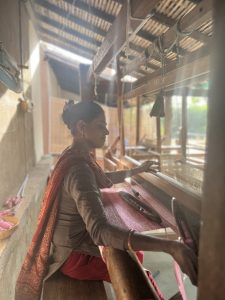
As Rajiben stretched her legs and got up, she told me to come upstairs with her. After climbing to the open second floor, I saw eight hand looms pushed towards the walls of the area. Rajiben clarified that these handlooms are used to train women through the weaving process which can take about nine months to learn. I had previously observed the plastic weaving process at Khamir’s workshop, carried out by Ranjanben, and was in awe of the intricate yet steady rhythm of her work. As we walked downstairs to sit back in our previous spots to continue with the interview, I grew curious about the up-cycled products of Rajiben’s enterprise and the way she marketed them to buyers. Rajiben explained that she partnered with Kaarigar Clinic, a rural development venture in Ahmedabad that connects rural and urban households. The organization bridges gaps for rural artisans by offering business training, technological support, design up-skilling, and marketing assistance, helping them promote their products to a wider audience. “We get 25% of what they sell, and they handle the design and marketing of our products,” says Rajiben. When asked about other buyers, she shares that now, as her work has become more recognized, other clients also reach out to her directly. Her daughter helps manage this by responding to inquiries through WhatsApp and Instagram.
While I sipped on the cool sprite that Rajiben had graciously offered me, I pondered whether Rajiben was happy with the work she did. Back in Jaipur, my colleagues often spoke about the stigma associated with waste work. Yet here was Rajiben, someone who had defied the odds as a woman weaver of her community carving her own path with quiet confidence. When I finally asked her the question that had been weighing on my mind, she replied, “I am happy, but also at the same time, not happy.” She spoke of her days as a textile weaver, of traditions in Kala Cotton weaving which had been her main work. However, the work of plastic up-cycling gave her meaning in not only providing livelihoods for women in Kachchh, but in saving the environment. “The cows are eating this plastic, people burn waste all around us and meaninglessly throw it everyday,” Rajiben asserted. She explained that her goal is to make a difference by helping remove plastic waste from Kachchh’s environment. Her enterprise already up-cycles more than 400 kg of plastic a year. While she could earn more by working as a textile weaver and continuing her community’s rich weaving traditions, she chooses to earn less, knowing that her work with waste benefits others as well. Ultimately, she hopes to shift attitudes toward waste within her community and takes pride in the progress made by the women she works with, many of whom now pass on this awareness to their families and children. As the interview draws to a close, I look through some of the up-cycled plastic products laid out in front of me and pick a spectacle case — a gift for my grandmother. Inside a small note reads, “Made by Rajiben.” It is a little piece of adversity and resilience embodied by Rajiben and the women of Kachch that I now carry forward to share.
Dr. Ismail Mohmed Khatri (Ajrakh Print)
The word Ajrakh comes from the Arabic word “azrak” meaning blue and it is a fitting origin as the Ajrakh print stands out for its intricate geometric and floral patterns in blues, reds, and blacks. The complexity and ornateness of this print and the vividness of the natural dyes makes it unlike any other block print that I have seen. When I first laid eyes on the Ajrakh scarf in Khamir’s shop, I knew I needed to discover more about its origin. Following my interview with Paresh Ji, he suggested I visit Ajrakhpur which led me right to the workshop of world renowned Ajrakh artisan, Dr. Ismail Khatri. Just like the Hindu Khatris, the Muslim Khatri community trace their origins to Sindh, later migrating to Kachchh. It is said that Rao Barmalji I, the King of Kachchh invited artisans from Sindh to settle in his kingdom and provided them land. While most Khatri block printers today are associated with Sunni Islam, there are also significant Hindu Khatris presence in Kachchh.
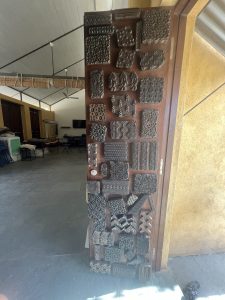
Ajrakhpur, the village where Dr. Khatri’s workshop is now located, is a relatively new settlement established after the devastating 7.7 magnitude earthquake in 2001 that struck the Kachchh region, claiming over 20,000 lives. Before the earthquake, the Khatri community practiced their centuries-old tradition of Ajrakh block printing in the village of Dhamadka, located about 40 kilometers away. However, due to water scarcity issues and the extensive damage caused by the disaster, some members of the community relocated to the newly formed village of Ajrakhpur to rebuild their lives and continue their craft, including Dr. Khatri. The first thing that caught my eyes as I entered the workshop was the door adorned with tens of old wooden stamp blocks. As I stepped through the door, I noticed an old man sitting to my left in front of a large, cluttered mahogany desk. He had a long beard and wore an Ajrakh pagri (headdress). Behind him an entire row of trophies revealed him to be Dr. Ismail Mohammad Khatri.
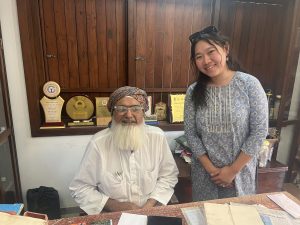
When I introduced myself to Dr. Khatri, he remarked that I had caught him at a good time, since he often found himself too tired due to his age to talk to visitors. He jokingly pointed out that this was the main reason for the creation of his 22-minute documentary on this ancient block printing craft, which was there for visitors to watch on a large screen. The sweltering heat in April had kept other visitors away and I considered myself lucky to sit in front of this man and have the chance to interview him. I started the conversation in Hindi, but Dr. Khatri replied in English. He has a good command of the English language, much better than my Hindi and I was more than happy to oblige. He tells me that he started learning English as a hobby after international visitors started coming to Kachchh to learn about natural Ajrakh print. Dr. Khatri’s father, Mohammed Siddique Khatri was an early pioneer in reviving the knowledge of natural dyes which he taught to his three sons. Dr. Khatri remarked, “my father had the divine knowledge to continue working with natural dyes which he taught to me. When my father started [block printing] it was natural and later it switched to chemical. When I started, it was chemical, and now it is natural again.” Chemical dyes had started to gain popularity in the 1940s with the introduction of naphthol which produced bright, vibrant colors unlike natural dyes. Naphthol also decreased the production time, generated consistent results, and used less water, making it extremely efficient. This was the reason many block printers in the Khatri community switched to using chemicals as water scarcity became prominent in the region.
Dr. Khatri’s profound knowledge, not only of Ajrakh, but also of the diverse motifs across the region, made it clear why he is considered a true master. While Ajrakh is influenced by Sufism and features geometrical patterns, other designs worn by communities around the region feature a lot of the natural world. Dr. Khatri spoke of designs that were specifically associated with a certain community or trade such as farmer designs (creeper, flower, tree) and motifs associated with the Rabari community (scorpion). He remarked that the Rabari, known for their camel herding and intricate embroidery work, would historically trade camel milk with the Jats of Kachchh for cloth. “You could differentiate people based on their clothing and the designs that they wore” he stated. When asked whether the designs have remained the same or evolved over time, Dr. Khatri explained that many are now blended and adapted to suit the modern market. He, too, has had to evolve with changing trends. He remarked that in the early 80s, designers from the National Institute of Design visited to assist with developing new motifs, color combinations, and layouts. At the time, artisans in Kachchh were relatively isolated, with little access to market trends or consumer preferences. Over time, as exposure to urban markets increased and his craft gained both national and international recognition, Dr. Ismail Khatri played a pivotal role in bringing naturally dyed Ajrakh into mainstream visibility. He helped make it accessible to a wider audience while ensuring the craft remained deeply rooted in its centuries-old techniques. Today, Dr. Khatri’s name has become synonymous with the revival and expansion of Ajrakh.
Reflections
As I reflect on my four days in Kachchh, I am reminded that what began as a professional inquiry into how Khamir connects rural artisans to the market, ended as something more —an exploration into the resilience of Kachchi communities and its artisans. From Mansukhbhai’s hope in Bela’s future, to the determined leadership of Rajiben’s in plastic up-cycling, and Dr. Khatri’s legacy in reviving Ajrakh, I saw how deeply craft is tied to one’s history and identity. These artisans are not just preserving their crafts, but adapting it to fit modern cultural, environmental, and economic realities. As someone working on the Bhayli project, to support women up-cycling initiatives, Khamir’s model rooted in empowerment and market access highlighted the importance of creating systems that place artisans at the center and encourage them as entrepreneurs. It reaffirmed to me that when artisans are given ownership and the right support, their crafts can be powerful tools for economic resilience and cultural continuity. I returned from Kachchh with not only a notebook full of insights, but with a deeper commitment to promote rural artisans that are at the forefront of crafting change.