*Conversations Unveiled – Pt. 1*
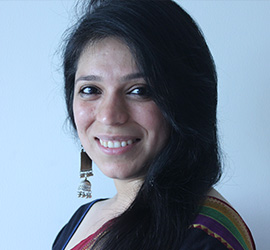
Ms. Neha Bhatia heads the operations of the SEE Learning Program® in India. She has over a decade of work experience in the corporate and non-profit sector, Neha is deeply passionate about working with Children and Youth and gets her energy from engaging with people and facilitating groups. Neha holds a Post Graduate Degree in Commerce (Business Management) from the University of Mumbai. She is a co-chair of UNESCO MGIEP’s Global Collective Working group for SEL and Emory University certified CBCT® (Cognitively-Based Compassion Training) Instructor.
In the month of November, through my Host Organization, Tech Mahindra Foundation, I received an opportunity to attend a 4-day educator prep workshop by SEE Learning India on Social, Emotional, and Ethical Learning. Working around mental health my interest in the subject was piqued and I decided to speak to Ms. Neha Bhatia from SEE Learning India to understand more about the space and the work she has been doing and here is how it unfolded.

About Social, Emotional, and Ethical Learning
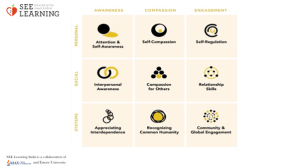
“So, SEE Learning is both a framework and a curriculum. Most Social Emotional Learning programs will have either, a curriculum or a framework so, what I find interesting is that SEE Learning has both a framework and a curriculum. The content of the Framework comes from the work of His Holiness Dalai Lama (Beyond Religion and Ethics for the New Millenium) and the structure of the Framework comes from the work Dr Daniel Goleman and Peter Senge have done in Triple Focus.
The curriculum is based on the framework and there is also a pedagogical model, what it does is that it builds on the existing SEL work that has happened in the last decade and a half, and also, brings on additional elements. Those elements are Attention training, Trauma-informed resiliency practices, systems thinking, or interdependence as we may call it. Of course, it draws from developmental psychology, neuroscience, and the study of contemporary research and it builds on a lot of these sorts of elements and incorporates it with the existing SEL work.”
The Origin and Expansion of SEE Learning
“So, SEE Learning is the vision of His Holiness, Dalai Lama and he has been for a very long time talking about writing and also engaging with educators to create or to encourage the educators to create something, what he refers to as “Education of the heart.”
He says education of the mind is important, but along with that, education of the heart is equally important, if not more so. One of the educators he spoke to was the Director of the Center at Emory University – the Center for Contemplative Science and Compassion-Based Ethics. Professor Lobsang Tenzin Negi, who used to be a Tibetan monk and has sort a Ph.D. in Western psychology and so he has one foot in the Indo Tibetan studies, and one foot in the contemporary world or Western psychology. So he was moved by this request that his holiness made to him and his team and then put together what now is called SEE Learning.”
Importance of SEE Learning
“I think His Holiness has said it better than anyone else can say, and I’m loosely quoting him, ‘If we can spend so much time and energy in learning math and science in school, then why not spend energy in learning about kindness and compassion?’ Some of these skills or practices are needed both by students and adults, only because it is a curriculum designed for students, it doesn’t mean it does not apply to us as adults. Regulating our own emotions, cultivating attentional stability, recognizing interdependence, and operating from that in the world today is needed by all of us and no one taught us about these practices or how to practice these skills in our everyday life.
If we are unable to regulate our own emotions as adults, if we’re unable to practice and embody some of these skills and practices in our own lives, then we can’t expect the next generation to. Look at us and learn, We Teach who we ARE, or We Teach the way we WERE Taught. And if we were to look at it through that lens, then no teacher training program teaches you or incorporates all of these elements when they’re training a teacher.
All of this is applicable not just in India, but all across the world and I think as adults when we are engaging with children the learning and engagement are not just at the end of the child. It’s equally or more sometimes at the end of the adult.
To also highlight the SEE Learning pedagogical model here, which is very deep because of what it is talking about. It is that the first level offers received knowledge which when we say refers to everything that let’s say you are hearing right now. Some kind of knowledge or information that you are collecting right now.
What will happen with that knowledge is the second level which is when you sit by yourself and think about it, when you reflect on this conversation and hear back or think back to what I’m sharing with you, you are going to sort of analyze this and put it in your logic and make sense of it, makes sense to you in your personal life through your personal experiences. This second level of our pedagogical model is critical insights. If you don’t have critical insights, then that knowledge is going to be some lecture, but that knowledge will become your knowledge when you will personalize it and use it, let’s say use your example in life to further the point that I’m making, because then that knowledge is not Neha given knowledge, but that that is something that’s coming from within you.
Both critical insight and received knowledge can be dangerous because then we can be stuck only at an intellectual level, and from my personal experience level, it can almost feed into people’s egos. But the third level is important, which is what we call embodied understanding because everything that we are talking about boils down to how we apply it in our own lives and how we practice, embody it, and make it second nature. So I can’t talk about kindness and compassion, draw insights about kindness and compassion from my own life and not practice kindness and compassion in everyday life.

Quoting a very well-known researcher, Dr. Kimberly Schonert-Reichl who researched that corroborates that teachers are emotional contagions and therefore, the wellbeing of children in the classroom is directly proportionate to the wellbeing of the teacher so, for the wellbeing of the child, we have to have healthy adults whose wellbeing is addressed and taken care of. This is what SEE Learning focuses on, the well-being of the teacher. The teacher is the wheel to take social and emotional learning to the students where the teacher herself is going through a process to go through the embodiment, along with encouraging her students to do that.”
About SEE Learning India
“At SEE Learning India, we are doing two things. One is the SEE Learning curriculum, a Hindi-translated curriculum available online that anyone can access and use as it is a free and open-source curriculum, in both English and Hindi. Secondly, there is SEE 101, which is an initial program that one could take as many hours because it is self-paced. It’s an orientation program that anyone can go through. Some readings will give you a little sense of what SEE Learning is.
We’re also doing a research project where we are trying to understand what is the implementation feasibility in India and what does that look like? And also to collect some data points on the situation of well-being in India, among Indian students or educators because we easily talk about and keep quoting data from the West, so we would like to develop data here in India.
There is another program that we offer, which is called CBCT, Cognitively Based Compassion Training, that the center at Emory University offers. We have certified instructors in India who can train people on CBCT and these people can be educators or anybody from any walk of life. This is a personal practice program. So while SEE Learning is for children, CBCT is for adults and it is more of a Contemplative practice-based meditation program. So for anyone who would like to develop a personal practice for their well-being, CBCT is the program to go for.”
Personal Experiences and Journey around SEE Learning and with SEE Learning India
“You know, one of the AHA moments or high points of my work, that gives me meaning is of course the depth of the work is not questionable at all. This doesn’t seem like work, right? It’s almost like so much personal development. In terms of work, what was interesting is when the pandemic hit, the life of the teacher changed overnight, they were sort of expected to “teach online” and in our case, at least most educators we worked with were women so they had responsibilities back home. Some of them were grappling with technology issues, and some of them were grappling with how to replicate the classroom online.
We at SEE Leaning India were also offering sessions, etc., and the teachers would show up again and again for sessions, and we didn’t expect the teachers to show up because the school is not asking you to show up. When the world was under lockdown, social-emotional learning was the last thing on everybody’s mind. What is it that’s making them come here? And that’s when we realized the importance of the work that we were doing because, unanimously teachers in all the spaces that they operate whether it’s their home, whether it’s their work, school, or whether it’s their family life or anywhere else, all of these spaces take off her.
This was one space that was helping them feel nurtured. And that’s when the penny dropped for us in some ways that what we were offering mattered beyond, and taking it to students and prioritizing it over math or science because it nurtured the teacher as a person. It let the teacher show up as a whole self, and that’s what touched us
It is a program that touches the human being, touches the individual, and that’s what we all are looking for at a deeper level. What are we looking for in life, we’re looking for nourishment, we’re looking for connection. We’re looking for authenticity, kindness, and acceptance and if there’s a space that can give them any of that, I can see how they would be drawn or any one of us would be drawn.
When we all talk about teacher well-being or the well-being of the person, the space for that person to be who they are, etc. But where is the time? Where do we give them the space? And I think the pandemic and programs like SEE Learning offers an opportunity to live what we are believing in. Any adult around any child needs to do that work for themselves. Here’s an opportunity for us all to do it, because whether you are a parent or not, whether you biologically have kids or not, whether you teach in the classroom or not we all have kids around us all the time and just the proximity of being around a child gives you enough reason to start doing that work on yourself.”
To be continued…
To know more:
About SEE Learning India
Link to the Website: https://seelearningindia.com/


