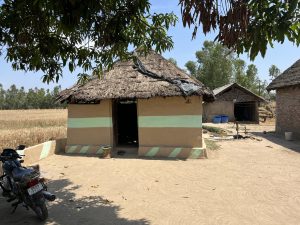
The Van Gujjar Basti, adjacent to the Ganga river in the Haridwar district of Uttarakhand, is unlike any rural communities I have seen in India. By that, I mean there is a strong presence of traditional architecture. In the rural communities I have visited so far, traditional houses have become more often a thing of the past as communities opt for structures made out of ‘permanent’ materials like concrete. There is a presence of modern structures, but many maintain aspects of traditional architecture like a thatched roof or the traditional square, single-room floor pan. The traditional houses, called Dero (डेरो), have an organic beauty about them owed to the mud walls and thatched roofs made out of grass collected from forests. Handmade wall art adorns both the interior and exterior of many homes, adding floral ornamentation that reflects the Van Gujjar Basti’s surrounding natural beauty. In the heat of late April, the cooling properties of traditional Dero houses are welcomed. However, community members assured me that even during bitterly cold Uttarakhand winters, the traditional dero remains comfortable and cozy. Immediately upon experiencing these climate-smart traditional houses, I became more eager to see how the Van Gujjar community adapted themselves and their surroundings to the environment.
The Van Gujjar Community
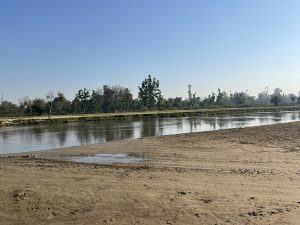
The Van Gujjar basti is situated just east of the Ganga river and on the periphery of the forest. This beautiful place was the setting for several days of learning, and unlearning. The Van Gujjar Basti is relatively recent and was established to accommodate the migration of many forest-dwelling Van Gujjar families to Uttarakhand’s tarai¹. Before their settlement in the tarai, the Van Gujjar community engaged in transhumance² with indigenous buffalo, or mains (मैंस). And until recently, the Van Gujjar economy relied solely upon transhumance with buffalo. Dairy products such as milk, lassi, yogurt, paneer, butter, and ghee have long nourished the community. In Uttarakhand, the Van Gujjar practice of transhumance took advantage of the geography of the Himalayan foothills. In summer seasons, Van Gujjars would travel with their cattle to alpine meadows for cooler grazing. In the winter, transition to the the lower altitude terai offered grazing in comparatively temperate conditions.
Van Gujjars are part of the larger Gujjar ethnic group which is spread out across North and West India and in neighboring countries such as Pakistan and Afghanistan. The Van Gujjar community told me that wherever Gujjar communities end up is the result of their traditional nomadic pastoralist livelihoods. Van Gujjar community elder and record keeper Mr. Vajeer Chopra explained this concept humorously:
“Most communities go wherever is best for their children. Gujjars go wherever is best for their Buffalo.”
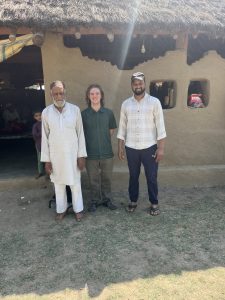
Gujjars, rather than leading their buffalo, follow their herds from place to place, prioritizing the comfort of their buffalo. This ensures a healthy herd that will provide for the needs of the community. For this reason, there is a special bond between Van Gujjars and their buffalo. Shamshaad Bhai tells me that when a boy is grazing his buffalo there is no other company besides the buffalo. The boy will speak to his buffalo and his buffalo will become his friends. Because of the mutual love and respect the buffalo are treated very well by Van Gujjar communities. Buffalo are kept in specially made shelters, well fed, and taken to the rivers and canals surrounding the community to cool off on hot summer days.
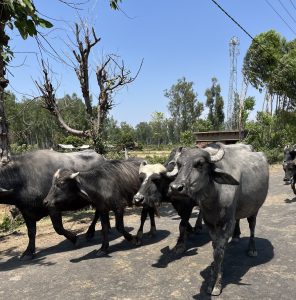
The traditional Van Gujjar practice of transhumance with buffalo is also a climate resilient practice that benefits both human and non-human communities. Buffalo dung is distributed to farmers to use as a bio-fertilizer which both enriches soil and provides an ecologically friendly alternative to chemical fertilizers that degrade vital soils. The buffalo that Van Gujjars keep is an indigenous breed that handles Uttarakhand’s extreme climates better than breeds that are net genetically acclimatized to the region. This make the breed more resilient and ensures resilience to extreme weather events associated with climate change. Van Gujjar transhumance with buffalo can also support forest renewal and biodiversity by spreading seeds around forest areas.
Van Gujjar Settlement

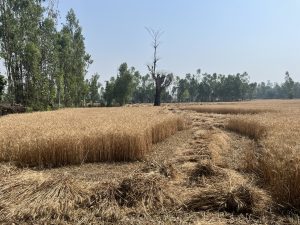
Presently and for the past several hundred years the Van Gujjar community has been settled in the forests of Uttarakhand because the geography and migration pattern is ideal for their buffalo. The name Van Gujjar means “forest” Gujjar referring to their habitation within the forest. However, today many Van Gujjars are now living in sedentary communities on the tarai of Uttarakhand in the Van Gujjar Basti. Although the Van Gujjars’ practice of transhumance has become less feasible and therefore less common, most families in the Van Gujjar Basti still keep buffalo. However, the Van Gujjar economy has diversified to include engagement in smallholder farming, non-buffalo animal husbandry, and working outside of the community in eco-tourism and domestic work, etc.
Van Gujjar Language
Like other Gujjar communities, the Van Gujjar community speaks Gojri. Van Gujjar elders and record keepers explained that Gojri has been heavily influenced by Gujjar transhumance livelihoods. As Gujjar people followed their livestock across North India, Gojri was influenced most notably by four regional languages. Those languages are Dogri, Panjabi, Rajasthani, and Gujarati. Historically, Gojri is an oral language. Today, Gojri is occasionally written in Devanagari (देवनागरी) or Nastaliq (نستعلیق). But Gojri has largely retained its strong oral tradition and remained a spoken, but not written, language. Today, Van Gujjars speak their mother tongue, Gojri, among other languages such as Hindi, Urdu, and English.
Van Gujjars and Scheduled Tribe Status
Gender and the Van Gujjar Tribe
Aamna, a final-year student pursuing a Bachelors of Fine Arts degree from Haridwar University, is paving the way for women in the Van Gujjar community to access education, share their stories, and gain recognition for their hard work. In our conversation, Amna spoke about the vital roles women fill within the Van Gujjar community. Mothers traditionally and contemporarily fulfill the role of Van Gujjar children’s primary educator. Mothers are storytellers, home economics teachers, and environmental and agricultural teachers.
Elders, especially women, are important storytellers because their stories help to maintain the knowledge of traditional livelihoods, even if they are no longer practiced. These stories contribute to the identity of the Van Gujjars. For example, Aamna told me about how elders often recall traditional clothing made of exceptionally long pieces of fabric. Sharing this knowledge on cultural as well as societal and environmental topics with young people contributes to their feeling of community belonging. These stories disseminate important information about practices that have aided the Van Gujjar community in thriving within the forests.
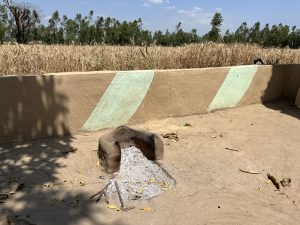
Women are also in charge of keeping the household as well as working alongside men in the field or with the buffalo. Within the household, the daily responsibilities of a woman would be to take care of the children and send them to school, collect milk and lassi from the buffalo, and manage the home. With the recent settlement, women now also work in the field collecting and selling wood in the winter and raising wheat in the summer. Some women even have work outside of their household doing domestic work and raising livestock. All of these essential duties necessitate skills that women are in charge of passing on to the next generation.
Aamna, in sharing this knowledge, communicated that she is hopeful that female role models will change the narrative within the community that women and girls should stay insulated in the community or shouldn’t aspire to reach for new opportunities.
Van Gujjar Cultural Context
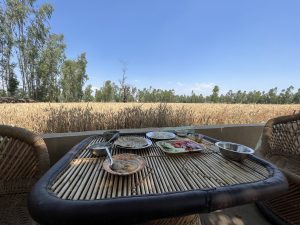
Although the settlement of Van Gujjar people from the forest into the tarai brought major livelihood changes, the community retains its own unique culture. The Van Gujjars are a Muslim Gujjar community and they have unique practices within their Muslim identity. For example, they typically eat little meat as compared to other Muslim communities and the Eid special in the Van Gujjar community is Kheer, or rice pudding. Weddings also have unique practices distinct from other communities. Van Gujjar weddings tend to be longer than most weddings to allow guests coming from far time to reach the event. During the mehendi, or henna, ceremony of the wedding, both women and men apply mehendi in traditionally simple designs to their hands. Another unique feature of Van Gujjar weddings is the tradition of the husband’s family gifting the couple buffalo.Community members tell me that the Van Gujjar community has developed strong community bonds. Van Gujjars are quite tight knit as evidenced by this Gojri saying:“Connections in the Van Gujjar community are like connections in the intestines.”The meaning of this phrase conveys one Van Gujjar individual can more often than not find a connection to another either in family or friends. However today this connectivity is decreasing now that many Van Gujjar people have settled in Uttarakhand’s tarai.Still, some Van Gujjar Basti enjoys some of the benefits of rural living with a tighter knit community. While we were sitting on his bike riding through the basti, Shamshaad Bhai endorsed the lifestyle in the Van Gujjar Basti saying that “what you get in the city is very limited”.
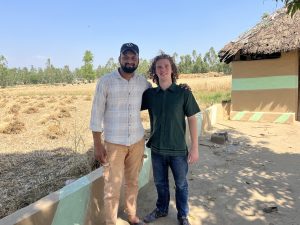
He elaborates that in the basti one may make or share what one needs from the abundant resources around found in nature. Meanwhile, those who live in the city must buy what they need from shops and are limited by the options presented by the market and are restricted but their finance.Van Gujjar community members have unique knowledge of their surrounding environments. They live close to nature and have reciprocal relationships with their ecological community from their buffalo herds to trees that provide medicine and fruits. A cornerstone of Van Gujjar identity is deeply rooted in a genuine connection to and knowledge of the ecologies that sustain community life and livelihood.
My Experience with the Samanta Foundation
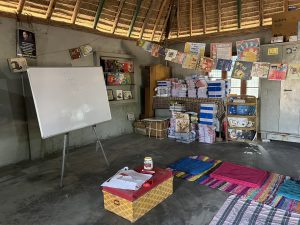
The Samanta Foundation serves the Van Gujjar tribe among other rural, forest, and tribal communities in Uttarakhand. Their work is centered around education but takes a holistic approach to helping communities access quality education that is considerate of community context. For example, the Samanta Foundation puts heavy emphasis on empowering communities to access education that is considerate of the linguistic and ecological context surrounding those communities.
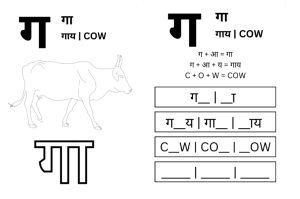
During my time with the Samanta Foundation, I was able to develop educational material for Van Gujjar children that accomplished the goals of being inclusive of the linguistic and ecological context of Van Gujjar children. I worked with community members and the Samanta Foundation team to create an interactive workbook that introduces young Van Gujjar learners to letters and Gojri vocabulary. We used contextual examples of flora, fauna and daily objects so that children could connect their learning with their environmental context. Additionally, I illustrated outlines depicting the vocabulary included in the workbook so that children could use their creativity and color in the workbook. The purpose of the workbook is ultimately to help children recognize Devanagari letters by associating them with familiar words in Gojri and Hindi. Additionally, children will be able to practice their fine motor skills by coloring in the illustrations and practicing their handwriting.Creating the coloring book was a more difficult task than I expected. Children needed to be familiar with the Devanagari script which is used to write Hindi and occasionally Gojri. Because the Samanta Foundation values the linguistic context of the Van Gujjar community, Gojri was made the priority language in the coloring book. However, not all Devanagari letters are represented in the Gojri language. This had to be strategically dealt with so not to confuse children who will be using this workbook. Ultimately, for letters that were only represented in the Hindi language, only the Hindi and English vocabulary words were presented. That way children could discover which sounds in Hindi are not represented in Gojri. Another challenge came with choosing which vocabulary words to use to represent letters in the Devanagari script. We wanted to choose vocabulary that children would easily recognize and could be depicted visually. This took a lot of back and forth, but ultimately the Samanta Foundation and Shamshaad Bhai helped me to select the best words for the coloring book.Learning about how the Samanta Foundation strategically works to educate youth was fascinating. Coming from work in climate change interventions with farmers, it was interesting to see how knowledge of one’s environment could be developed from an early age. Appreciation and familiarity with their environment as well as an education that values their linguistic and ecological context will empower the Van Gujjar community to build upon their resilience to economic, social and environmental change.
What I’ll Take with Me
Experiencing Van Gujjar culture and environment and engaging with education campaigns in the Van Gujjar Basti has allowed me to further understand how education today can develop communities while empowering them to maintain cultural practices and knowledge that proves useful in climate resilience and ecological restoration. Although the popular paradigm dictates that humans are at best separate from and at worst antagonizing of nature, work in which grassroots communities can employ their traditional knowledge and steward their land will mitigate land degradation. My now enriched understanding of the connections between indigenous communities, their land, and education will surely influence me to value contextual education in support of communities, their ecologies and their languages.
Acknowledgements
Shamshaad Bhai is an excellent friend, father, and leader who cares about both the development of his community as well as maintaining its unique and valuable indigenous knowledge and culture. His insights into life, livelihood, and surrounding ecologies are nothing short of inspiring. I am very grateful to him for supporting me in my visit to his community. I must also thank him for welcoming me into his community and providing both good company and delicious meals!
Guneet Bhai is a dedicated team member at the Samanta Foundation. Guneet has been incredibly helpful as I delved into the important work carried out by the Samanta Foundation. His commitment to bettering access to education for rural, tribal, and forest communities is commendable. I have great admiration for Guneet’s hard-earned understanding of the communities he works with. I thank him for all of the logistical, technical, and general support during my time in the Haridwar District.
Aamna Bahan’s storytelling, personal journey, and action are sure to empower the next generation of women in her community. I must thank her for sharing her story and knowledge with me.
Prashant Ji and Tanya Ji are the founders and co-directors of the Samanta Foundation. They have so kindly encouraged my exploration of their unique and ever-important work. Prashant and Tanya’s vision and love for the communities they work with is reflected in the Samanta Foundation’s initiatives.
Thank you to the American Indian Foundation, its donors, and its staff for making this journey and my learning from it possible via the Banyan Impact Fellowship’s ‘Professional Development Grant’.
1. The fertile plains situated just before the foothills of the Himalayan mountain range.
2. A type of pastoralism in which livestock is moved seasonally – usually between higher and lower altitudes.


