This blog is co-authored by AIF Banyan Impact Senior Fellow Dilip Surkar.
The importance of drylands¹ cannot be understated. Drylands, including arid, semi-arid, and sub-humid ecosystems, constitute 46% of earth’s total land, support 50% of the world’s livestock, and host nearly half of all cultivated systems (UNCCD 2012: 31). Given that one in three of all crops cultivated today has drylands origins, it is evident that drylands are essential habitats of both economically significant flora and fauna as well as wildlife. However, drylands are under threat due to climate change that compromises the feasibility of drylands livelihoods like agriculture and animal husbandry (UNCCD 2012: 31). Drylands meet the needs of approximately one-third of the global population by providing resources such as food, water, and shelter.

Therefore, the health of drylands affects even those communities and anthropogenic systems that are not directly economically reliant on these ecozones. Climate change-induced threats to drylands must be addressed swiftly in a manner that not only sustains but enhances drylands-dependent livelihoods. Drylands in North Gujarat are especially vulnerable to these threats. However, North Gujarat is also becoming a model example for climate-resilient intervention.

The Drylands of the Santalpur Block
Drylands, including arid and semi-arid areas, pose unique challenges related to livelihoods, agriculture, and environmental sustainability. The Patan district in Gujarat, India, is one such region facing these issues. The Santalpur block of the Patan district, is a remote and arid to semi-arid area located in Northern Gujarat (Patan District Administration 2023). The major economic activity in Santalpur is agriculture and the majority of people engaged in agriculture can be categorized as small or marginal farmers.² In 2019, the Indian Council of Agricultural Research (ICAR) assessed that the Patan district faces ‘high’ vulnerability and risk due to climate change (Rao 2019). The Santalpur block’s high vulnerability to climate change can be attributed in large part to its unique and remote geographic, ecological, and economic conditions.
Challenges in the Santalpur Block
Santalpur, being a dryland, is more vulnerable to water scarcity as the “intensity and return period of major drought events have increased substantially in the last two-three decades” subsequent to climate change (Hiremath 2012: 39). Agriculture in this area is largely rain-fed and is affected by water scarcity as well as unpredictable rainfall. A lack of irrigation infrastructure prevents farmers from getting any water to their fields and this limitation exacerbates challenges they face in crop production.
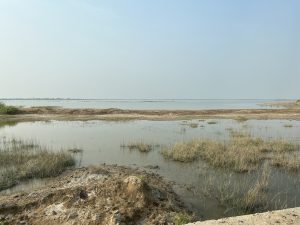
Santalpur, the Patan district’s easternmost block, has naturally saline soil as it abuts the Little Rann of Kutch, a salt marsh in Gujarat. Soil salinity is also on the rise due to seawater ingress into Santalpur’s aquifers.³ Groundwater in Santalpur has been exploited for agricultural, industrial, or domestic use faster than it can be recharged by rainfall or water bodies leaving aquifers empty (Charry 2021). Consequently, saline sea water intrudes on emptied aquifers that are normally occupied by freshwater. Saline groundwater seeps into soil from the aquifer or via irrigation. Soil salinity affects the ability of many crops to grow to their full potential which in turn decreases crop yield and contributes to livelihood insecurity in the Santalpur block (Shrivastava & Kumar 2015). Furthermore, soil salinity contributes to erosion, further leading to land degradation in the block. High soil salinity discourages ground cover in the form of vegetation that keeps soil in place. With the variability of weather due to climate change and erratic rainfall, soil runoff is yet another threat to Santalpur’s ecological health and agriculture-based livelihoods (Queensland Government 2023).
Soil degradation is further exacerbated by the use of pesticides and chemical fertilizers, reducing its productivity. As climate change reduces crop yield, the use of these chemicals reduces soil health by removing organic matter that supports life. Overgrazing of cattle, goats, and sheep accelerates land degradation as livestock removes vegetation needed to contribute to and protect healthy soil. This issue is compounded by the fact that 40-60% of Patan’s total land is already considered degraded and wasteland – that is land that has already been degraded by anthropogenic interventions to the point where it is no longer productive for agriculture (Patan District Administration 2023). Furthermore, the overuse of pesticides and chemical fertilizers can negatively affect the health of farmers, village communities, and consumers.
The lack of diversity in crops raised in Santalpur poses a significant challenge to ecology, community health, and livelihood security. Cash crops in the form of monocropping, or planting only one crop, increases farm vulnerability to climate change. Different crops are vulnerable to increasingly erratic weather events in different ways. It is possible that an entire field of mono-cropped crops could be too severely affected to be sold or continue growing to produce a good yield. As a result, income is reduced, and farmer livelihoods are put in peril (Singh et al. 2022). Intensive mono-cropping also contributes to land degradation. Additionally, lack of crop diversity can make it difficult for communities to meet their own nutritional needs (Hiremath 2012).
Climate change is constraining economic opportunities in a remote region that already faces economic challenges in accessing markets and diversifying income, which is causing out-migration and putting pressure on urban areas that already struggle to meet the needs of their populations (LSE South Asia Centre 2013).

What can be done?
The prognosis of the impact of climate change, especially on drylands is understandably concerning. Fortunately, through “land restoration, sustainable land management and nature-positive agricultural practices” there is great promise that dryland livelihoods including agriculture can not only be sustained but also enhanced (UNCCD 2023:8; Charry 2021).
The importance of indigenous knowledge and land management using native plants and livestock cannot be understated when it comes to climate resilience. For example, many of the cash crops grown on farms today demand more water. Authorities on land restoration and climate resilience assert that the redeployment of varieties of crops that can deal with dryland conditions better is essential to mitigate the impacts of water scarcity. Indigenous varieties of crops do the best job in this case (Hiremath 2012). This is true of livestock too. For example, indigenous breeds of cattle cope better with the arid Santalpur climate than non-native cross-bred cattle (Ahlawat 2014). Applying both traditional cropping patterns like mixed cropping and shifting cultivation can also prove fruitful in land restoration. Indigenous, tried-and-true farming practices are some of the most effective and efficient ways to halt or even reverse desertification (UNCCD 2021). Promoting agroforestry, horticulture, silvipasture, plantation on farm boundaries could improve productivity and biomass availability in these regions.
On top of that, advances in science and technology can also support efforts to mitigate the impacts of climate change on dryland livelihoods. The introduction of weather monitoring systems, salinity and drought resistant crop varieties, and the revision of planting dates are already building climate-resilience in vulnerable areas (Hiremath 2012). It is crucial that innovative irrigation infrastructure is installed in the Patan district as to mitigate water scarcity and sustain agriculture in the region. For example, the precision farming technique of drip irrigation delivers small amounts of water via a pipeline system to multiple crops so that water is conserved but water intake of plants is not reduced. There is a need to ensure ‘More Crop Per Drop’ by increasing water use efficiency.
Economic challenges should not be ignored when searching for climate-resilient solutions. Especially in the case of the remote Santalpur Block, private sector participation in climate resilience is indispensable. It is increasingly in the interest of private actors to lend themselves to the conservation of drylands so that economically significant agricultural activities can be sustained. Plus, for private actors, resilient intervention is a chance to innovate and add value to agricultural goods (Ludi et al. 2018). Addressing the challenges faced by drylands require a multi-faceted approach involving government initiatives, community participation, and sustainable development practices tailored to the specific needs of Northern Gujarat. Collaboration between various stakeholders is crucial for the long-term well-being of both agricultural economic activity and local ecology in the region.
More to come…
Amidst the several challenges, lie opportunities for innovative conservation strategies and sustainable management practices. Efforts to enhance resilience, restore degraded landscapes, and promote community-based conservation can contribute to safeguarding the unique biodiversity of drylands while addressing the broader impacts of climate change on these ecosystems. The fragile nature of drylands presents a call for adaptive approaches that integrate local knowledge, science, and policy to navigate the complexities of climate change and biodiversity conservation in arid and semi-arid regions.
Footnotes
- The definition of ‘drylands according to Jonathan Davies of the International Union for conservation of Nature is:
“Drylands are defined using an Aridity Index (AI), which is calculated by dividing mean precipitation by potential evapotranspiration. Drylands have an AI of 0.65 or lower, meaning that potential evapotranspiration is at least 50% greater than actual mean precipitation” (Davies 2017, 3).
- The criteria for the classification of small farms and marginal farms are based on total land area. Small farms are two or fewer hectares in area while marginal farms are one or fewer hectares in area (Press Information Bureau Government of India 2019).
- “An aquifer is a body of saturated rock through which water can easily move. Aquifers must be both permeable and porous and include such rock types as sandstone, conglomerate, fractured limestone and unconsolidated sand and gravel” (What is an Aquifer? 1999).
References
Ahlawat, A.R. et al. “Climate Change and Domestic Animal Biodiversity: Gujarat Perspective”. 2014. https://www.researchgate.net/publication/268689187_Climate_Change_and_Domestic_Animal_Biodiversity_Gujarat_Perspective. Accessed 3 January 2024.
Hiremath, Deepa B., and Shiyani R.L. “Adapting Gujarat to Climate Vulnerabilities: The Road Ahead.” Research Journal of Recent Sciences, vol. 1, no. 5, 2012, pp. 38-45. ISCA, https://www.isca.me/rjrs/archive/v1/i5/6.ISCA-RJRS-2012-100.pdf. Accessed 10 January 2023.
Charry, G.R. et al. “Impact of climate change on runoff potential and planning of interventions for sustainable agriculture in Northern Gujarat zone using geospatial techniques.” Proceedings of Virtual National Conference on Strategic Reorientation for Climate Smart Agriculture, Ludhiana: Punjab Agricultural University, 2021, pp. 50-53. ResearchGate, https://www.researchgate.net/profile/Amarinder-Singh/publication/352440961_Simulation_of_adaptation_measures_to_climate_change_using_CSM_-DSSAT_model/links/60c9d8c7a6fdcc0c5c86ff8d/Simulation-of-adaptation-measures-to-climate-change-using-CSM-DSSAT-model.pdf#page=63. Accessed 16 December 2023.
Davies, J. “The Land In Drylands: Thriving in uncertainty through diversity” UNCCD Working Papers, 2017, https://www.unccd.int/sites/default/files/2018-06/15.%20The%2BLand%2Bin%2BDrylands__J_Davies.pdf
LSE South Asia Centre. “What Drives Migration in Northern Gujarat?” LSE South Asia Centre Blogs, LSE South Asia Centre, 6 March 2013, https://blogs.lse.ac.uk/southasia/2013/03/06/what-drives-migration-in-northern-gujarat/. Accessed 23 February 2024.
Singh, H.P. et al. “Shodh Chintan.” National Conference on Climate Resilient and Sustainable Development of Horticulture, New Delhi: ASM Foundation, 2022, Vol. 14. ResearchGate, https://www.researchgate.net/profile/Parthsarthi-Pandya/publication/365822520_Approaches_for_Climate_Resilient_and_Sustainable_Development_of_Horticulture_in_Gujarat/links/638597f5554def619380fe63/Approaches-for-Climate-Resilient-and-Sustainable-Development-of-Horticulture-in-Gujarat.pdf. Accessed 21 December 2023.
Patan District Administration. “District at a Glance.” Patan District, 16 December 2023, https://patan.nic.in/district-at-a-glance/. Accessed 13 December 2023.
Press Information Bureau Government of India. “Categorisation of Farmers”, 5 February 2019, https://pib.gov.in/newsite/PrintRelease.aspx?relid=188051
Rao, R. et al. “Risk and Vulnerability Assessment of Indian Agriculture to Climate Change.” National Innovations in Climate Resilient Agriculture, ICAR, Hyderabad, 2019, http://www.nicra-icar.in/nicrarevised/images/publications/Risk%20&%20vulnerability%20assessment%20of%20Indian%20agriculture%20to%20climate%20change.pdf. Accessed 3 January 2024.
United Nations Convention on Combating Climate Change (UNCCD). “Drought Data Shows ‘an Unprecedented Emergency on a Planetary Scale’.” Bonn: United Nations Convention on Combating Climate Change, 2023, www.unccd.int/news-stories/press-releases/drought-data-shows-unprecedented-emergency-planetary-scale-un. Accessed 3 January 2024.
United Nations Convention to Combat Desertification (UNCCD). Global Land Outlook, Second Edition: Land Restoration for Recovery and Resilience. Bonn: United Nations Convention to Combat Desertification, 2021, https://www.unccd.int/sites/default/files/2022-04/UNCCD_GLO2_low-res_2.pdf. Accessed 4 January 2024.
Ludi, E. et al. “Unlocking Climate Resilient Economic Development in Drylands: Pathways to a Resilient World. PRISE Submission to the Talanoa Dialogue.” London: Pathways to Resilience in Semi-arid Economies, 2018, https://unfccc.int/sites/default/files/resource/431_PRISE%20submission%20to%20the%20Talanoa%20Dialogue.pdf. Accessed 3 January 2024.
Queensland Government. “Impacts of Salinity” Queensland Government, https://www.qld.gov.au/environment/land/management/soil/salinity/impacts#:~:text=Salinity%20is%20often%20associated%20with,vulnerability%20of%20soils%20to%20erosion. Accessed 16 January 2024.
Shrivastava, P. and Kumar, R. “Soil salinity: A serious environmental issue and plant growth promoting bacteria as one of the tools for its alleviation.” Saudi journal of biological sciences vol. 22,2 (2015): 123-31. doi:10.1016/j.sjbs.2014.12.001
“What is an Aquifer?” The Digital Atlas of Idaho, Idaho State University, 1999, https://digitalatlas.cose.isu.edu/aboutus/sref.htm