Migration trends and the vulnerabilities among migrant families
Migration shapes the socio-economic landscape of India, with industrial hubs like Ankleshwar and Bharuch in Gujarat serving as key destinations for migrant laborers. These twin townships, now united under the Bharuch Ankleshwar Urban Development Authority (BAUDA), are home to the country’s largest industrial zones, and Asia’s largest chemical estate. With over 3.6 lakh residents, including 1.4 lakh migrants, this region continues to attract workers from rural parts of Rajasthan, Uttar Pradesh, Bihar and Madhya Pradesh. However, behind this economic activity lies a story of resilience and hardship.
For many migrant families, however, the promise of a better life comes at the cost of dignity and stability. Life in the BAUDA region is marked by economic struggle and social exclusion. Migrant laborers often endure poor working conditions, driven not by choice but by the harsh realities of poverty in their home states. Their contributions power the industrial success of Gujarat, yet they remain marginalized, with limited access to basic rights and dignity. As Kiran Desai from the Center for Social Studies, Surat, aptly states, “The prosperity of a minor section of the affluent class is built on the inhuman exploitation of vulnerable migrants.”
According to a UNICEF research brief referencing the 2011 Census, one in every five migrants in India is a child. Gujarat is among the states with the highest percentage of child migrants, accounting for 20.5% or 4.46 million of its population. Migration significantly impacts children’s lives, as studies show they often lose the safety nets provided by their social networks in their home regions. This displacement puts their overall well-being at risk.
Research indicates that children from the least impoverished groups fare much better in terms of wealth, school attendance, and lower rates of child labor compared to those from the most economically disadvantaged groups. On the other hand, children from the poorest migrant families face greater challenges, including increased engagement in labor and fewer educational opportunities. Further analysis reveals that boys, children from the poorest families, and those belonging to Scheduled Tribes (ST) or Muslim households in rural areas are at a higher risk of being involved in work. This early entry into the labor force prevents children from acquiring essential skills for future employment, perpetuating the cycle of poverty across generations.
Barriers to Education for Migrant Children
Frequent Relocation: The frequent relocation associated with migration disrupts a child’s continuity in education. Admission processes in public schools can be cumbersome, and many children find it difficult to re-enroll after moving to a new area. Even when they manage to secure admission, the inconsistency in their schooling history and the constant need to adapt to new environments and curricula place them at a disadvantage. These disruptions often result in children falling behind academically or dropping out of school entirely.
Lack of Documentation: Migrant families frequently move between regions, and their transient lifestyle often results in incomplete or missing documentation, such as birth certificates, transfer certificates, or proof of residence. Many public schools require these documents for admission, and the absence of proper paperwork can prevent children from enrolling. Even when exceptions are made, the process can be lengthy and discouraging for families already struggling with daily survival.
Lack of Essentials: Another major obstacle is the lack of nutrition and essential resources. Many migrant families live in precarious conditions, struggling to meet their basic needs. Children often experience malnutrition, which negatively affects their cognitive abilities and capacity to concentrate in school. Additionally, the lack of access to resources like books, uniforms, and transportation further hinders their ability to attend and benefit from school. Economic constraints also play a critical role. Migrant families often prioritize earning a livelihood over education, as they rely on every member of the household to contribute financially. Children may be required to work alongside their parents to supplement the family income, leaving little time or energy for schooling.
Language and Cultural Disconnect: When families migrate to different regions, the medium of instruction in public schools often differs from the children’s native language. This linguistic gap makes it difficult for migrant children to comprehend lessons, participate actively in class, and keep up with their peers. Migrant children may also experience a sense of alienation in mainstream schools. Differences in customs and social norms can make them feel like outsiders, leading to a lack of confidence and reluctance to engage with their peers or teachers. This cultural disconnect is often compounded by societal biases, where migrant families are viewed as “outsiders,” further isolating their children within the school environment.
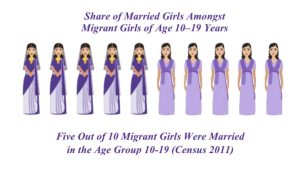
Child Marriage among Migrant Children: Child marriage is a significant concern among migrant children, especially girls. Census data from 2001 and 2011 shows that 39.3% and 33.5% of migrant children aged 10-19 were married, compared to just 4.8% and 4.5% of non-migrant children. The problem is more severe for migrant girls, with 61.7% married in 2001 and 52.7% in 2011, compared to 7% and 6.2% of non-migrant girls. For boys, the numbers were similar between migrant and non-migrant groups, around 3-4%. Child marriage among migrant girls limits their access to education, skill-building, and job opportunities, perpetuating their vulnerability.
The barriers to education faced by migrant children are not just logistical challenges—they are systemic failures that deny them their right to learn, grow, and break free from the cycle of poverty. Frequent relocations, lack of documentation, malnutrition, and linguistic and cultural disconnects are not mere inconveniences; they are chains that shackle entire generations, perpetuating inequality and dimming the prospects of a brighter future. These obstacles are a glaring reflection of a society that allows its most vulnerable children to be left behind.
A Ray of Hope: Aarti Play School
Amid this challenging backdrop, Gram Vikas Trust’s Aarti Play School in Ankleshwar is a beacon of hope for migrant families. This initiative is designed to address a crucial gap—providing foundational literacy and numeracy skills to children from migrant communities in their native Hindi language. The school focuses not only on academics but also on the all-around development of children, nurturing their physical, emotional, social, and cognitive growth. It goes beyond the traditional classroom setup by implementing a highly personalized approach to education. Recognizing that every child is unique and learns differently, the school ensures the use of Teaching-Learning Materials (TLM) specifically designed to cater to the individual needs of each child. The school’s TLM is developed with the understanding that many of its students come from homes where formal education is limited. The materials incorporate culturally relevant and relatable examples, allowing children to connect their learning to their everyday experiences. To ensure holistic well-being, every child receives a nutritious meal daily, an essential support given the precarious living conditions many face.
At regular intervals, Arti Play School organizes meetings with the community members, especially mothers, to foster a sense of shared responsibility and collaboration. These meetings serve as a platform for discussing each child’s progress, addressing concerns, and celebrating milestones, no matter how small. These meetings also serve as a medium for trust-building and awareness. For many migrant families, formal education is an unfamiliar concept, and skepticism or hesitation is common. By involving mothers in the educational journey, the school helps simplify the process and highlights its long-term benefits.


“The early years (0 to 8 years) are the most significant period of growth and development in the life of a child. It is during this period that the foundation for the holistic development of the child and the child’s future learning are set up. Strong foundations in the early years have a lasting impact on children’s development and are considered to be critical inputs in improving the enrollment and participation of children in formal schooling.” – Ministry of Education, India
Redefining Freedom: Breaking Generational Poverty Through Education
During my visit to Ankleshwar, I witnessed first-hand the harsh realities faced by migrant workers. Living in cramped 8-12 square meter houses, for which they pay ₹2,000 in rent, these workers earn a daily wage of ₹450—when work is available. The unpredictability of their income makes affording even basic necessities a daily struggle.
One moment stood out to me during this visit. We came across a child playing dangerously on a staircase with no railing during school hours. Concerned for his safety, my colleagues and I visited his house to persuade his parents to send him to Aarti Play School. We explained how the school provided everything- education, meals, uniforms, and learning materials at no cost. However, the mother’s response was both heart breaking and eye-opening. “We can never escape poverty,” she said, “Our children will also die working like us, living here.” Her words revealed a deep sense of resignation, shaped by generations of limited access to education and resources. For her, the idea of a better life for her child seemed impossible—a painful reminder of how systemic poverty fosters a mindset of inevitability.
At that moment, my colleague, Mr. Jalinder Shinde, turned to me and asked, “So how do you feel, Nupur? We’re in the 77th year of independence.” His question lingered in my mind as I reflected on the reality before me. Independence, I realized, isn’t just about freedom from external oppression; it’s about breaking free from the chains of hopelessness and despair that poverty creates.
In the 77th year of independence, true freedom means breaking free from the constraints of generational poverty. Every child in Aarti Play School represents not just a learner but a spark of hope—a promise that education can rewrite destinies and reshape communities. It is education that can ignite hope, build resilience, and create opportunities for children to dream beyond survival. Yet, the journey to break the cycle of poverty requires more than just resources—it calls for empowering communities to believe in the possibility of change.
REFRENCES:
https://www.unicef.org/india/media/3416/file/child-migration-india2020-policy-brief.pdf. Accessed 12 Mar. 2024.
Desai, Kiran. “Migrant Workers, the Nowhere People of ‘Gujarat Model.’” Deccan Herald, https://www.deccanherald.com/india/migrant-workers-the-nowhere-people-of-gujarat-model-698960.html. Accessed 12 Mar. 2024.
“Bharuch Ankleshwar Urban Development Authority (BAUDA).” Bharuch.gov.in, bharuch.gujarat.gov.in/bauda-bharuch-ankleshwar-urban-dev-autho. Accessed 3 Dec. 2024.
“Understanding Foundational Literacy and Numeracy.” education.gov.in, www.education.gov.in/nep/understanding-FLN. Accessed 3 Dec. 2024.