- SAHELI acts as a social flywheel, addressing inequality in India through a self-sustaining cycle of health, education, and economic empowerment.
- The program begins with menstrual health education and reproductive health education, helping girls stay in school and improve their well-being.
- By building confidence, leadership, and skills, SAHELI establishes career readiness and fosters equality in India, enabling girls to challenge societal norms.
- Through economic empowerment and community support, SAHELI drives lasting change, creating a ripple effect that breaks systemic barriers for future generations.
India is home to 120 million adolescent girls (Ministry of Statistics & Programme Implementation (MoSPI) ‘Youth in India 2022’ report), of which 23% drop out of school when they hit puberty owing to a lack of functional toilets in school premises, according to a 2023 UNESCO report on Menstrual Health and Hygiene Management. Besides menstruation impeding the continuation of schooling, bias also plays a role. The World Economic Forum says, “increasing girls’ secondary school completion rates can lead to a substantial increase in a country’s GDP, with estimates suggesting a potential 10% growth by 2030.” In other words, investing in girls’ education just as we do in boys has the potential to uplift the entire country while also advancing multiple UN Sustainable Development Goals (SDGs).
There is no silver bullet solution to address the problem of inequality in India. Addressing inequities requires continuous education, empowerment, and opportunity – a self-reinforcing cycle of interventions that creates a ‘social flywheel,’ generating momentum for greater equality. AIF’s Support Adolescent Health, Education, and Livelihood Initiative (SAHELI) is one such integrated approach that develops a sustainable system where adolescent girls and boys are educated and empowered to lead their lives with a shared sense of ownership/purpose.
With a particular focus on addressing the unique needs of women, children, and youth, SAHELI aims to make a profound and lasting impact on these marginalized groups in the areas of health, education, and livelihood, where each intervention strengthens the next, reinforcing progress and helping break the cycle of inequality in India. The SAHELI program is built on three main pillars:
1. The First Push: Menstrual Health and Reproductive Health Education
In India, myths and stigma surrounding menstruation and reproductive health often lead to poor health outcomes and reduced opportunities for girls, which perpetuates inequality. An article by UN Women about period poverty shares how millions of women and girls cannot afford menstrual products or access to safe water and sanitation for menstrual hygiene. With more than 1.5 billion people lacking basic sanitation amenities such as private toilets, women stay away from school and work during their periods, leading to the disruption and discontinuation of many adolescent girls’ learning journeys. A recent study in Odisha revealed that 46.9% of girls were uninformed about menstruation before their first period, leading to feelings of fear and embarrassment at menarche.
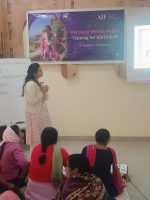
SAHELI’s holistic approach to education is backed by an understanding of the research and centered on the awareness of how inadequate menstrual hygiene and poor nutrition both keep girls from school. Through regular sessions with adolescent girls on sexual and reproductive health, hygienic menstrual practices, and nutrition, the integrated program empowers them with knowledge and offers support for responsible decision-making. SAHELI provides awareness on cervical cancer, identifies anemic girls and facilitates hospital referrals, and works collaboratively with schools and communities to help girls overcome barriers to their health and education.
The foundational knowledge of health and menstrual hygiene that the girls acquire enables them to stay in school and improve their health. In 2023-24, SAHELI reported a significant reduction in incidences of severe anemia, which dropped from 1.73% to 0.39% within a year. Additionally, to foster an open, inclusive environment, SAHELI works with adolescent boys to ensure that menstrual health is a shared dialogue, not just a girls’ issue.
Anshu, a 16-year-old from Kharasrot village in Yamkeshwar, faced severe health challenges while pursuing her grade 11 studies. She was diagnosed with critically low hemoglobin levels during a SAHELI health camp in February 2023, and her condition worsened after contracting jaundice, with hemoglobin dropping to life-threatening levels. The SAHELI team, along with the AIF Health Facilitator (AHF), intervened, arranging her hospitalization and a life-saving blood transfusion. With treatment, counseling, and a nutrient-rich diet, Anshu’s hemoglobin rose to 12.5 by January 2024. Now hail and hearty, Anshu remarks, “I’m grateful to the SAHELI team for their support during my illness. Their guidance helped me recover and return to school, stay healthy, and focus on my studies. SAHELI has truly changed my life.”
2. Building Momentum: Instilling Confidence and Leadership Skills
India houses one of the largest adolescent populations in the world, with 253 million individuals between 10 and 19 years old. In July 2024, India’s Ministry of Health and Family Welfare released a report, ‘The Economic Case for Investment in the Well-being of Adolescents in India,’ which provides a comprehensive framework for supporting the adolescents that will comprise its coming demographic dividend. AIF’s SAHELI initiative, which has had a demonstrable impact on the well-being of adolescent girls, is aligned with government priorities.
Providing education alone isn’t enough if girls lack the confidence to apply their knowledge. SAHELI equips girls with essential skills to live and work in the 21st century and prepares them to transition into adulthood by assisting them with competitive exam preparation, improving digital literacy, providing career counseling, and organizing career day events to help students from grade 9 onward explore future work opportunities. The program enhances their English proficiency through remedial sessions for below-average students and trains teachers in techno-pedagogy to address teacher shortages and outdated teaching methods. SAHELI also conducts sessions on computational thinking, cyber security, and gender awareness.
3. Fostering Lasting Change via Economic Empowerment
When girls become economically self-reliant, they challenge traditional gender roles and norms in their communities, an outcome that will help break the cycle of inequality in India. Financial independence enables girls to move out of poverty and develop the courage to bust myths and social taboos within their communities.
SAHELI helps girls become economically independent by focusing on skill development and workforce readiness. The program’s multidimensional approach empowers girls who are drop-outs, providing them with vocational and soft skills training, placement support, financial assistance, and entrepreneurship mentoring. By also providing market access, AIF creates a supportive ecosystem for them to excel in their fields. The program also offers grade 12 students the opportunity to explore fields like IT and communication, supporting their career goals. In 2023-24, an evaluation showed that 51.6% (48 girls) were employed after graduating from school, collectively earning over Rs. 15 lakh (over $17,000) on an annual basis, while 18.3% opted for further studies.
Riya’s journey with SAHELI is a strong testament to the achievements of the program. Riya found herself grappling with fatigue due to anemia, making it hard for her to keep up in school. Through the SAHELI program, she received personalized nutrition counseling and essential medical support, which helped her regain her health and energy. After completing grade 12, she enrolled in a 6-month beautician course in Rishikesh. With SAHELI’s support and mentorship, Riya opened her own salon, creating not only a thriving business but also a safe space for other women in her community to learn and earn. Today, Riya is a successful entrepreneur who has turned her personal journey into a source of inspiration and empowerment for others like her.
The Self-Sustaining Impact of the Social Flywheel
True equality can be achieved when women support women and lead by example within their communities. SAHELI aims to help girls build agency in the crucial years of adolescence, transition into adulthood seamlessly, and empower them to support future generations in their communities. By collaborating with stakeholders and adapting to community needs, the program drives transformative change and promotes sustainable development.
To date, SAHELI has empowered 8000 adolescent girls and 6500 adolescent boys and trained 242 ASHA workers. It has a presence in more than 520 villages and has transformed 28 schools. Since its inception in June 2022, SAHELI has had a positive ripple effect on adolescent girls’ families and communities, which has contributed to breaking the systemic barriers that propagate the cycle of poverty and inequality in India.
To learn more about SAHELI, please visit the program page.
Are you a corporate or organization looking to support equality and equal opportunities? Partner with AIF.