My visit to Kamakyanagar, Odisha, was my first field visit explicitly related to my work at my host organization. I was assisting with a project that sought to understand how communities benefit from institutional monitoring and evaluation tools. The research question was abstract and layered in many aspects. Asking people to reflect on a reflective practice would be a struggle to communicate even in the same language.
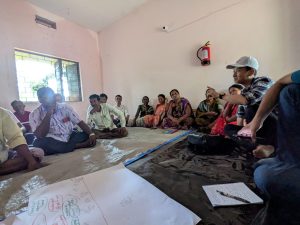
This visit involved the daunting task of filtering these questions through three languages—English to Hindi to communicate with the local NGO team members, and from Hindi to Odia for the team members to communicate with the communities whose opinions we sought. We received answers through the same filtration process: Odia to Hindi, and Hindi to English.
There was a surrealness to asking a question, hearing the response, and realizing that the question asked by you was not the same one heard by the respondent. This was a struggle that I, weirdly, had not expected to encounter, either because of hubris or a confidence in the practice of translation. For reference, below are the questions we hoped to gather answers to, informing a use case for learning, monitoring, and evaluating tools across contexts.
| Area | Facilitating org | MAP convening org |
| Purpose, value |
|
|
| Use of insights |
|
|
| Domains of interest |
|
|
| When to use |
|
|
| Feedback loops |
|
|
| Ownership & accountability |
|
|
| Participation & representation |
|
|
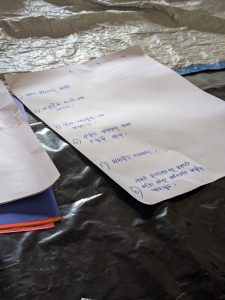
Though the questions are relatively clear, the specifics and nuances of each language slightly alter the meaning of sentences, which may sound intuitive in English but come off as clunky and confusing when directly translated. In my past work, where I had to translate from English to Hindi and vice versa, I almost always encountered a sentence that would make much more sense if it were reworked conceptually in the other language, as opposed to simply translated.
The function of translation in the fieldwork setting is not linguistic accuracy but the transmission of ideas. The team member I traveled with, who is Indian and spoke Hindi well, remarked to me on the side how even the first translation of our questions into Hindi seemed to alter the nature of the question. When we received our answers in Odia, they were translated to Hindi again, and I had to do the work of translating them back to English for our notes. I felt as if the limits of my language ability were being reached. I had to do the work of not literally translating but perceiving how the altered nature of the question, when it was translated, would have also altered the response, translating with that change in mind.
To supplement this head-spinning exercise, I had to read between the lines and gather opinions from the subtleties of how respondents spoke—their body language, tone, and inflection. Even the way they perceived our questions could tell us a lot about their thought process in thinking about these tools.
There was also a layer of trust we needed to have with the team members we were with, to translate not literally, but to get to the gist of the ideas being expressed. This became especially important during moments when, for 10–15 minutes straight, community members would be having a lively debate in Odia. It is impossible to offer a direct translation for every comment made; it becomes up to the translator to condense that conversation into its core ideas. Despite the barrier, the way the debate played out was full of human signals that we all could perceive, and that, combined with a summary from our team, provided rich data nonetheless.
This field visit was a reminder that translation is not a mechanical process, but a very human unfolding.