As part of the Professional Development Grant offered by the American Indian Foundation (AIF), I had the opportunity to attend the Great Place To Work For All Summit 2026, held on 10th February in Mumbai. It is known as one of India’s flagship gatherings where leaders come together to discuss what it means to build workplaces that truly work “for all”.
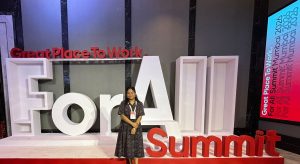
To be honest, the experience felt a little overwhelming at first. Being in a room with over 1,200 attendees from the corporate sector, many of them senior leaders with years of experience, was something I had never experienced before. Most of my work and exposure so far have been in the social impact space, so stepping into a new environment felt really unfamiliar. But at the same time, it was exactly the kind of exposure I was hoping for through this grant, especially since my fellowship work focuses on building disability-inclusive workplaces, thereby ensuring sustainable livelihood opportunities for people with disabilities.
Observing the Summit Through an Accessibility Lens
The summit, organized by Great Place to Work India, gave me a chance to see how workplace culture and leadership are discussed in corporate India. Over the past few months, I have started observing spaces around me through an accessibility lens. This summit offered many insights in that regard. The venue itself was designed to be accessible, and the conference room was spacious enough to support mobility. The summit experience also incorporated multiple accessibility features, including large, easy-to-read text on screens, clear audio announcements, and, notably, the presence of Indian Sign Language (ISL) interpreters throughout the event, which were introduced this year.
One small yet meaningful detail that stood out was that each attendee received a basic sign language poster by the “WeLoveSign” company in their goodie bag, subtly encouraging greater awareness and adoption of sign language. Another interesting feature was a live doodle artist who visually captured key ideas from each session, making the content easier to understand and more engaging.

Key Themes from the Summit
The summit’s theme this year was “The Great Adaptation: Where Change Meets Opportunity.” It also featured an interesting line-up of speakers, including former Indian cricket captain Mithali Raj, author & public intellectual Gurcharan Das, industry veteran CP Gurnani, and Founder of Genpact, Pramod Bhasin. Across sessions, leaders shared a common message: organizations that prioritize trust, people, and employee experience perform better. They adapt faster in a changing world. The shift is now towards treating employee experience as a strategic priority, alongside the growing focus on inclusive leadership in an AI-driven workplace. This reflects how organizations in India are beginning to embed people-first thinking into business strategy.
Reflecting on Inclusion in Practice
Engaging with the HR leadership ecosystem through this summit allowed me to see how inclusion is being understood and practiced within corporate India. The summit focused more broadly on building workplaces that work “for all.” But it made me reflect on how these ideas translate in reality, especially for persons with disabilities.
There is a growing understanding that inclusive workplaces are important for performance and long-term success. However, I noticed that disability inclusion is still not deeply built into these conversations. Even when inclusion is discussed, the way policies, systems, and experiences are designed can play out very differently for people with disabilities. This makes it important to bring disability inclusion into these discussions more intentionally. Because without that lens, broader ideas of inclusion may not fully address their realities. While awareness is increasing, it often remains at a surface level rather than being fully integrated into organizational strategies. This reflects a larger issue, as persons with disabilities continue to face barriers in employment and workplace participation.
Moving Beyond Hiring
One of my biggest learnings was that inclusion cannot stop at hiring. Organizations need to integrate inclusion across the employee lifecycle: from hiring to retention to growth.
Many organizations are making visible progress in inclusive hiring. However, there is comparatively less focus on creating environments where PwDs can thrive and advance into leadership roles. Disability hiring often remains limited to certain types of disabilities. This happens due to assumptions about “ability,” which excludes a significant section of talent.
Through my work with AIF’s DI-verse certification initiative, I have been engaging with a structured framework. It aims to help organizations move beyond surface-level inclusion by assessing and strengthening areas such as accessibility, policy design, leadership commitment, and talent development. At the summit, I realized how important such frameworks are. They help bridge the gap between intent and actual practice.
Addressing these challenges requires sustained investment in accessible infrastructure, inclusive policies, manager sensitization, and clearly defined pathways for career progression. Without these elements, inclusion risks being limited to representation rather than enabling meaningful participation.
Strengthening the Business Case
The summit highlighted how people’s practices impact performance. But there is still room to connect disability inclusion more clearly to outcomes like productivity, innovation, and market value. Research shows that organizations that are more inclusive tend to perform better. This makes disability inclusion not just the right thing to do, but also a smart business decision. It also requires moving beyond basic accommodations. Organizations need to adopt universal design approaches that benefit everyone.

Overall, the summit showed that India’s workplace landscape is evolving. There is a strong intent to build better workplaces. At the same time, there is more work to be done.
For me, this experience helped bridge my understanding of social impact and corporate practice. It strengthened my perspective on disability inclusion. I now see it not only as an issue of access and equity, but also as a strategic tool to build more inclusive and future-ready organizations.
References:
- Great Place to Work India. For All Summit™ 2026. Great Place to Work India, 2026, www.greatplacetowork.in/for-all-summit/
- Accenture. Getting to Equal: The Disability Inclusion Advantage. Accenture, 2018.


