Vikalp works with young girls who are at risk of child marriage; for them, the future is everything. Vikalp’s curriculum involves workshops and activities surrounding “dreams”. “Aapka sapna kya hai?”, girls are often asked (“What is your dream?”). Facilitators ask the girls to close their eyes and imagine themselves in one year, five years, ten years. Women hold few positions of power; many students will say “teacher” because that is the position they have seen a woman in. But, with some prompting questions (“Is there anything a man can do that a woman can’t?”) girls suggest more and more lofty ideas; starting at a police officer, a lawyer, a dancer, all the way to an Instagram model or Prime Minister.

It is no secret in this Fellowship (or my blogs) that I love art, and I will insert it into any activities. Part of this is influenced by my schooling; many activities I did as a young kid in Cambridge, Massachusetts involved art. Above the entryway to my school was a huge mural depicting Martin Luther King (the school’s namesake) and freedom fighters. Anywhere you looked, there was graffiti on the walls. Art wasn’t a hobby of mine at the time, it was an integral part of my life, and my understanding of identity and culture.
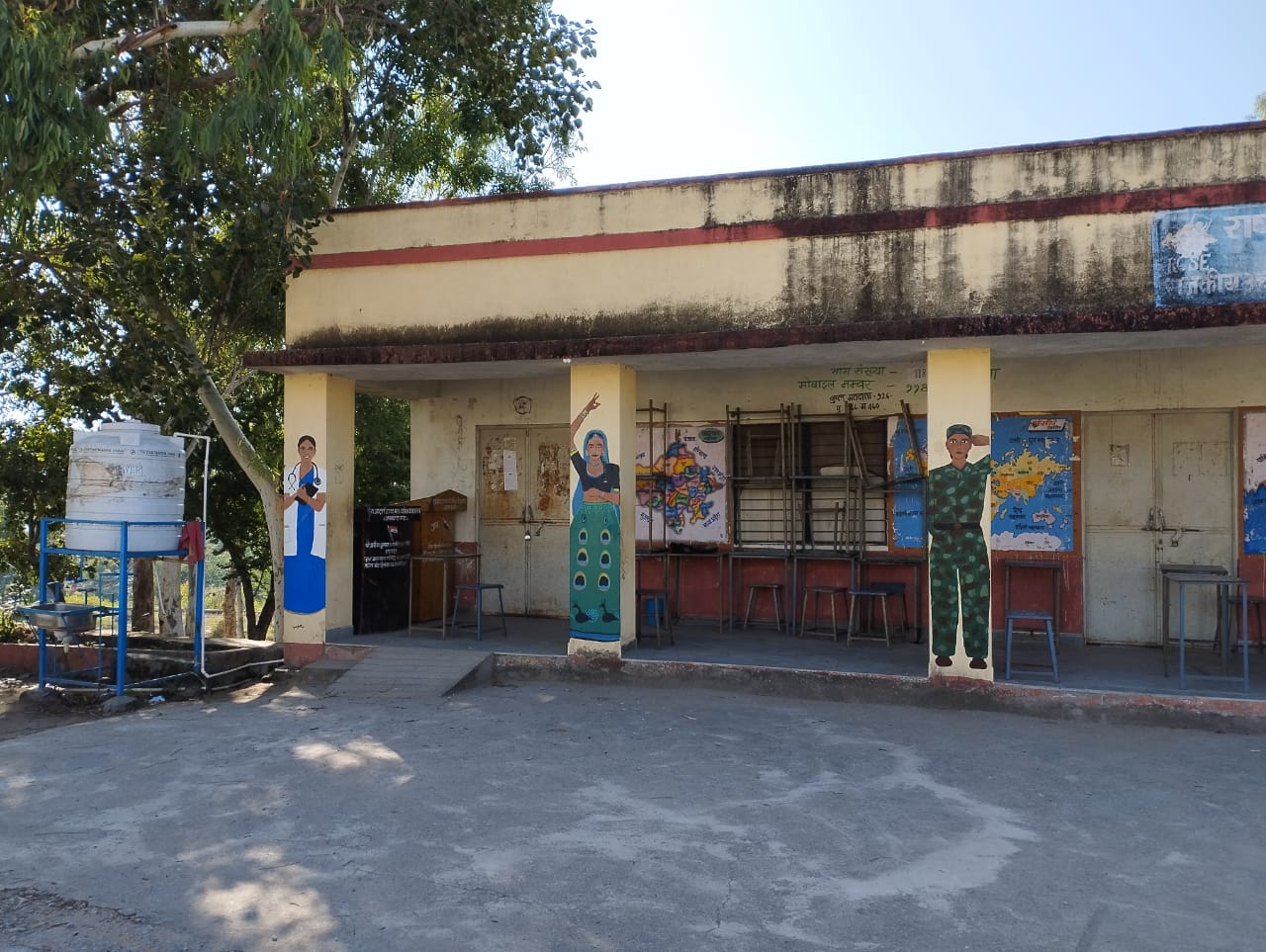
In December, with the help of my coworkers, I began a Wall Painting initiative in the Gogunda block. I met with the students in Jaswantgarh, aged 10-18. Their principal, a poised, confident woman, was extremely helpful and supportive and strongly encouraged the girls to participate. In the first part of the workshop, they brainstormed and wrote on the board about possible jobs a woman could have. They closed their eyes and imagined themselves as their dream.
“Now we will draw it!” I said. In my mind, that was the logical next step. But the girls looked at me blankly. Draw what? “Yourselves as these dreams,” I clarified. They were excited to see drawing materials but looked very stressed at the prospect of free drawing. “Didi, I don’t know how to draw”, and “I’m going to mess it up”, were the sudden protests. It took some convincing and drawing a figure on the board for reference, but eventually, each girl took a paper and began to draw. As they got absorbed in recreating the perfect colors, shapes, and borders to complement their drawings, they laughed, chatted, and helped one another. 

The process was a bit clunky and touch-and-go, like most things in their first stages. What I had planned with the help of my coworkers, some mentors in my hometown, and my supervisor, did not necessarily go as planned. I was unprepared for the cultural barrier in the sheer lack of arts programming in schools; which in retrospect felt obvious. But the idea and the feeling of bringing art as an expression was there. When I told them their paintings were going on the school walls, I could see their excitement grow. Inside the school were seven pillars, and we decided it would be perfect to transfer their dreams right onto them. Hence, each pillar became a woman in a different job; teacher, lawyer, businesswoman, doctor, dancer, police officer, soldier. I drew the outlines, and girls of all grades filled in the big blocks of color. There was a calm and silence as the students got absorbed in the flow of the painting process. More and more girls joined to paint a section, pour out more paint for others, and wash brushes. As we were leaving, they waved goodbye and insisted we come back as soon as possible to finish the mural and do more art together.
It was the best feeling for me to hear from the girls how much they enjoyed the process; especially given how unfamiliar they were with art at first. Hear from them firsthand in this video by myself and my colleague, Juhi Vaishnav:

Stay tuned for our next mural!


