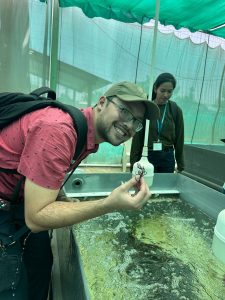
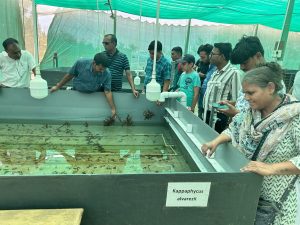
Recently, thanks to the support of AIF and Utthan, I had the chance to attend the 16th edition of the Central Salts and Marine Chemicals Research Institute’s (CSMCRI) Seaweed Cultivation and Processing Technology Training (SEA-CPT). Over three days, I attended sessions covering the background and technical needs of seaweed cultivation, as well as the state of the industry in India. What I found most crucial to share from this training was the opportunity that NGOs and coastal communities have to create new forms of sustainable industry.
Worldwide, seaweed processing is an old industry, having been practiced in Japan since the 1700s. Nowadays, the industry has expanded to over 35 million tons produced annually, with China and Indonesia leading production. Despite having over 7000 km of coastline and a high population dependent on marine-based livelihoods, India contributes less than 0.01% to the global production of seaweed, either cultivated or wild. However, India has a large domestic demand for seaweed based products, due to its large industries in pharmaceutical production as well as for sourcing vegan replacements for gelatin and other gelling agents. While the largest industrial extracts from seaweed are agar agar and carrageenan (common food additives for gelling), India’s CSMCRI has developed methods to process the remaining biomass into agricultural biostimulants, resulting in no wasted biomass as well as promoting sustainable farming techniques.
Part of what makes seaweed so attractive as a sustainable livelihood is its potential as a zero-land crop. It requires no freshwater, no fertilizers, and no additives. It can grow directly in or in conjunction with fisherpeople’s traditional fishing areas, helping coastal communities diversify incomes and add value to existing Farmer Producer Organizations (FPOs) or Self-Help Groups (SHG). While its larger environmental impact and potential risks to native species have not been fully studied, current researchers expect that by prioritizing tribal knowledge and local production, this industry can avoid the environmental risks of commercialization.
India has several schemes oriented towards ensuring that the budding industry grows inclusively with coastal communities. This includes the PMMSY scheme (Pradhan Mantri Matsya Sampada Yojana), which invests over 640 crore rupees into helping farmers build nets and startup seaweed based businesses (Department of Fisheries). Additional potential livelihood opportunities beyond farming include seedling cultivation, industry seaweed agents, or off-season product creation, like seaweed khakra being developed by local Farmer Producer Organizations (FPOs) partnering with Pidilite, a major CSR leader in this field.
Recently, Utthan, my host organization, signed a Memorandum of Understanding (MoU) with the CSMCRI, seeking to continue their word in building livelihoods across Gujarat through a pilot seaweed seedling farm training project. Alongside the other interventions we have in place in coastal areas, this will continue the meaningful work towards empowered women in an equal world as well as ensure that this blue boom of coastal livelihoods does not leave women behind. With the support of research initiatives like SEA CPT to prepare leaders at the industry scale and NGO partner support at the grassroots level, India is preparing to become a seaweed powerhouse.

All information sourced from trainings at the Central Salts and Marine Chemicals Research Institute’s (CSMCRI) Seaweed Cultivation and Processing Technology Training