Checklist
Banners across the stage.
Lamp for inauguration.
Booths for artisan products.
Guest list.
Catering.
MC script.
I had done this before. Or at least, I thought I had.
Planning in a Different Rhythm
On paper, Annual Day felt familiar. I had experience with event planning in the United States, where timelines are fixed, email threads are long, and everything is confirmed weeks in advance.

Here, it moved differently.
Decisions flowed through WhatsApp.
Plans shifted closer to the date.
Catering was finalized last minute, not out of chaos, but preference.
At first, it felt like things were slipping. Then I realized this was the system. Flexible. Adaptive. Responsive in ways I hadn’t experienced before.
At the same time, the scale was far greater than anything I had managed. Over 500 beneficiaries. Competitions, stalls, logistics, coordination. And all of this alongside my regular work in impact evaluation and data analysis.
It was overwhelming. Until it wasn’t.
More Than an Event
What appears externally as a year-end event for CSR partners is, at its core, something much more intentional.
There were no phones.
No recordings.
No pressure to perform for anyone outside the room.
Instead, it was a rare space where women could gather and celebrate without shame, embarrassment, or fear. A space where they did not have to explain themselves, ask for permission, or hold back.
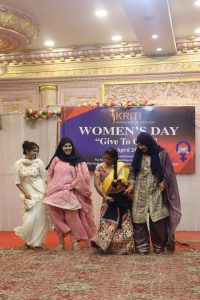
From qawwali performances to vibrant dances and powerful poetry, the women shared their talents, dreams, and deepest thoughts. Some spoke about education. Others spoke about independence, confidence, and the futures they hoped to build. Every performance carried a story.
For a few hours, the room belonged entirely to them.
What It Meant
For many women, spaces like this are rare. And because of that, the significance of the evening stretched far beyond the event itself.
It became something they could carry with them in memory, in confidence, and in the quiet reminder of what it felt like to exist freely, even if only for a few hours.
For some, it was their first time on a stage. For others, it was the first time they had publicly shared a dream of attending university, starting a career, or becoming financially independent. Standing before hundreds of people, they spoke words and expressed themselves in unimaginable ways.
After every performance, one word surfaced again and again:
Pehchaan.
Identity.
Not as an idea, but as something deeply felt.
Every woman in the room arrived with her own story, skills, ambitions, and passions. For one evening, they were not defined by their relationship to someone else—not someone’s wife, daughter, daughter-in-law, or mother. They stood as individuals in their own right.
Their names belonged to them.
Their voices belonged to them.
And for perhaps the first time in a long time, so did the stage.
What Stayed With Me
I had approached Annual Day as something to plan and execute. A logistical challenge. A break from my usual work.
But it became something else entirely.
A reminder that impact is not always something you measure or document. Sometimes, it is something you protect. Something you make space for.
And something people carry with them, long after the event is over.


