AIF
  • Home
  • India Service Application
  • US Service Application
  • Senior Fellows Track
  • Meet Our Fellows
  • Alumni Corner
  • Blog
  • Publications
  • Get In Touch
  • FAQ

May 11, 2023

We use our eyes every day. Why not take care of them?

Silpaa Gunabalan AIF

Our eyes play an essential role in our day-to-day activities, so it is crucial not to take them for granted. Vision impairment is defined as any kind of vision loss that cannot be returned to the “normal,” whether that is total blindness or partial vision loss. Globally, at least 2.2 billion people experience vision impairment. Almost half of these cases could have been prevented or have yet to be addressed. Since working at Forus Health, I have learned the importance of prioritizing eye health to prevent blindness. My project focuses on scaling up the company’s eye screening solution to make comprehensive eye exams more accessible to people throughout India. In this blog, I hope to convince you to prioritize eye care.

How does vision loss impact my quality of life?

Good eye health is crucial to maintaining a good quality of life. We use our eyes to read, watch movies, go on hikes, and do work. Vision impairment can severely hinder one’s quality of life. Changing vision can cause symptoms including headaches, dry eye, and eye strain. With the increasing role of technology in work-life, the issue of vision loss is becoming more prominent. Adults with vision impairment often have lower rates of workplace productivity and participation, and they are more likely to experience anxiety and depression. 

If one’s vision continues to regress, the impairment can have severe impacts on one’s independence. Additionally, vision loss can have a substantial economic impact as a result of added medical expenses and loss of productivity. In 2020, the estimated annual global productivity loss due to vision impairment was about US$ 411 billion.

How do I take care of my eyes?

looking at patient's retina during eye exam
Forus Health optometrist doing retinal imaging during a comprehensive eye exam

There are a few things we can do in our day-to-day to maintain healthy eyes. First, diet plays a role in preserving vision. Eating foods high in antioxidants and omega-3 fatty acids, especially, helps to keep your eye healthy. Additionally, protecting your eye by wearing glasses and eye shields can be beneficial depending on your activities. For example, if you work in the manufacturing industry, wearing safety goggles is necessary to prevent damage.

The most important step one can take to care for their eyes, however, is to get routine, comprehensive eye exams. During my fellowship, I experienced the importance of these eye exams for one’s eye health, as I witnessed optometrists at my host organization diagnose patients with vision impairment. The comprehensive eye exams provided by Forus Health test visual acuity, eye movement, colorblindness, dry eye conditions, intraocular pressure, and retinal health. By getting routine eye exams, eye doctors can identify eye problems at their earliest and most treatable stage, thereby preventing further damage or blindness.

Who should get their eyes checked?

Everyone should get their eyes checked! While the majority of people who experience blindness are over the age of 50, vision impairment affects people of all ages. Most people should get their eyes checked every two to three years. However, if you have existing vision impairment or are at risk for eye disease, it is recommended to get a comprehensive eye exam every year.

Why are comprehensive eye exams necessary?

Many people think their eyesight is normal, but this is impossible to know without a comprehensive exam. When you experience vision loss over time, your brain adapts in a way where you will not notice a vision change. Many eye diseases do not have visible symptoms until they are too late to be effectively treated. It is essential to get your eyes tested for the following reasons.

Early Detection of Eye Diseases

As mentioned earlier, preventing blindness is one of the most important reasons to routinely get your eyes checked. Early on in my fellowship, I learned that the most common diseases that contribute to preventable blindness are glaucoma, age-related macular degeneration, diabetic retinopathy, and cataracts. All of these diseases do not display symptoms at early stages. Ophthalmologists often detect eye diseases by observing changes in the appearance and structure of eye anatomy over time. As a result, these diseases can only be effectively treated through routine eye exams.

During one of my visits to an eye screening camp, one of the people being tested complained about blurred vision. After performing fundus images and taking the person’s intraocular pressure, the optometrist referred her to an ophthalmologist, fearing that she had glaucoma which needed to be addressed immediately. Glaucoma is a disease that damages the optic nerve which eye care providers detect by measuring your eye pressure.  With early detection, eye care specialists can offer multiple treatment and medication options to decrease eye pressure and significantly slow or prevent vision loss. When people fail to get their eyes checked, they often sustain permanent eye damage before they are aware of having glaucoma.

Detection of Other Chronic Diseases

Not only can eye exams tell you about your eye health, but they can give you information about your overall health as well. The retinal examination portion of an eye exam can be life-saving by allowing eye doctors to look at the small blood vessels in the back of your eyes. Retinal images can help ophthalmologists detect chronic health conditions such as high blood pressure, high cholesterol, diabetes, and multiple sclerosis, all of which can be life-threatening. The image to the right provides more information about what eye doctors look for when diagnosing these conditions.
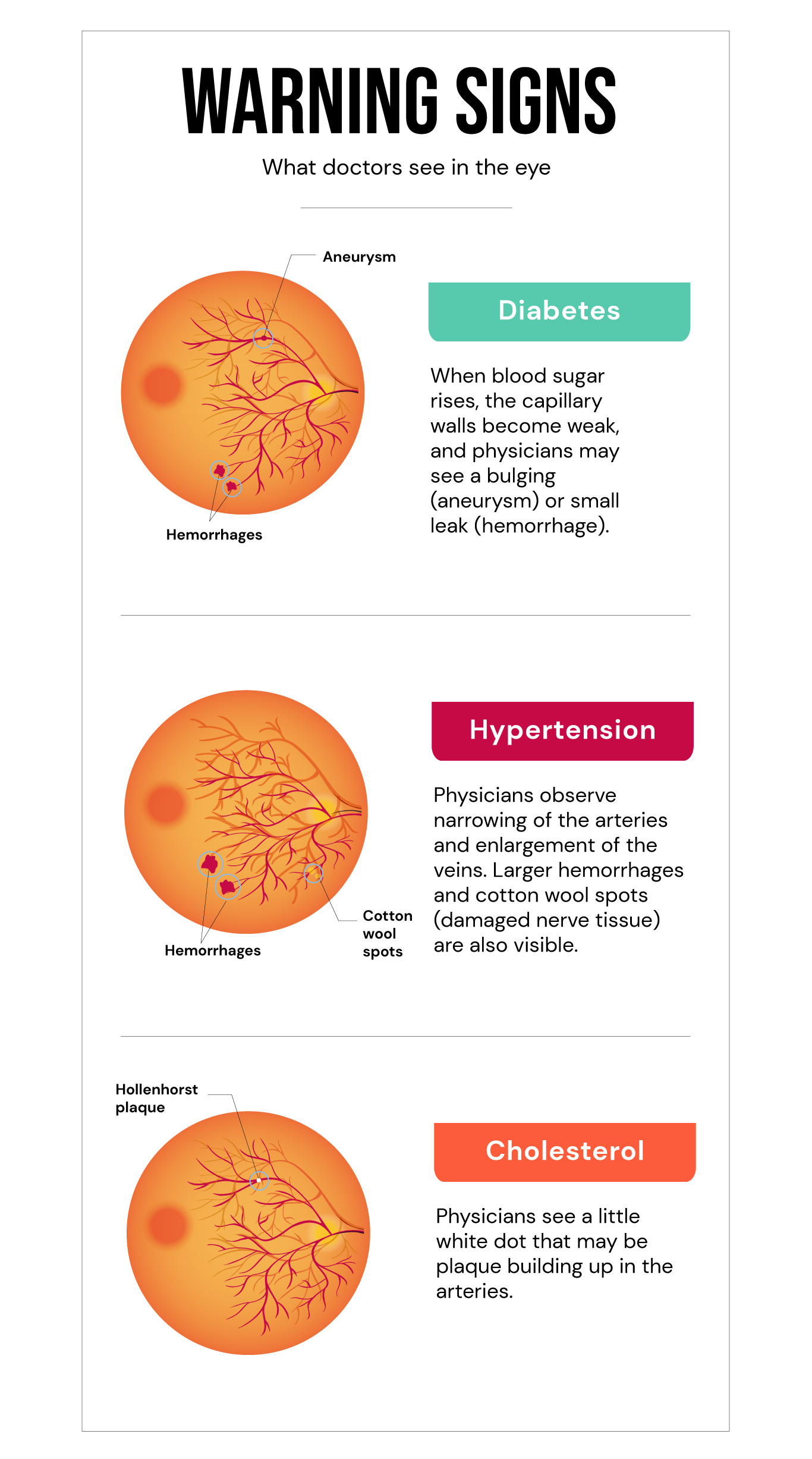
describes how doctors use the retina to detect chronic diseases
Using the retina to detect chronic diseases (Source: Blue Cross Blue Shield MA)

While the results of an eye exam can help healthcare professionals detect these chronic diseases, they are not a diagnosis. However, the information from a comprehensive eye exam encourages patients to seek treatment for potential chronic diseases and address them earlier. This leads to lower medical spending, less loss in work productivity, and better overall health outcomes.

Currently, Forus Health is working on an artificial intelligence program to detect possible chronic diseases using retinal images. This system could revolutionize preventive care and early detection of chronic diseases in India.


Maintaining one’s eye health is necessary for maintaining good overall health. It is important for everyone to regularly get their eyes checked to prevent irreversible damage to vision. Through my work with Forus Health, we are trying to make eye care more accessible to people throughout India, ensuring that those who are most susceptible to eye disease will have access to care.


References:

Impact of Eye Exams in Identifying Chronic Conditions – Unitedhealth Group, www.unitedhealthgroup.com/content/dam/UHG/PDF/2014/UNH-EyeExamsChronicConditions.pdf. Accessed 10 May 2023.

“Keep an Eye on Your Vision Health.” Centers for Disease Control and Prevention, 1 Oct. 2020, www.cdc.gov/visionhealth/resources/features/keep-eye-on-vision-health.html.

MA, Blue Cross Blue Shield. “3 Big Reasons to Get Your Eyes Checked Regularly.” Coverage, 13 Apr. 2023, coverage.bluecrossma.com/article/3-big-reasons-get-your-eyes-checked-regularly.

Vision Effects on the Quality of Life – Shreejieyecare.Com, www.shreejieyecare.com/images/pdf/eye%20care/preventive%20eyecare.pdf. Accessed 10 May 2023.

“Vision Impairment and Blindness.” World Health Organization, www.who.int/news-room/fact-sheets/detail/blindness-and-visual-impairment. Accessed 10 May 2023.

Author

  • Silpaa Gunabalan
    Silpaa Gunabalan

    Silpaa Gunabalan is serving as an American India Foundation Banyan Impact Fellow with Forus Health in Bengaluru, Karnataka. For her fellowship project, she is helping to develop an economic model to increase access to vision screening services. Silpaa is from Pleasantville, New York. She studied Human Biology, Health, and Society at Cornell University in Ithaca, New York. She is passionate about global health and health equity. While at Cornell, she participated in global health research in Mosh, Tanzania where she investigated acute respiratory infection in children under five. Additionally, Silpaa recently worked at a free health clinic in New York City where she spoke with patients to identify the social determinants of health they experience. She hopes that this experience will aid her while doing community outreach during her fellowship project. Silpaa’s family lives in Coimbatore, Tamil Nadu which inspired her to pursue this fellowship opportunity. She is excited to immerse herself in Indian culture while learning more about effective global health solutions.

    View all posts
silpaa-gunabalan

Silpaa Gunabalan is serving as an American India Foundation Banyan Impact Fellow with Forus Health in Bengaluru, Karnataka. For her fellowship project, she is helping to develop an economic model to increase access to vision screening services. Silpaa is from Pleasantville, New York. She studied Human Biology, Health, and Society at Cornell University in Ithaca, New York. She is passionate about global health and health equity. While at Cornell, she participated in global health research in Mosh, Tanzania where she investigated acute respiratory infection in children under five. Additionally, Silpaa recently worked at a free health clinic in New York City where she spoke with patients to identify the social determinants of health they experience. She hopes that this experience will aid her while doing community outreach during her fellowship project. Silpaa’s family lives in Coimbatore, Tamil Nadu which inspired her to pursue this fellowship opportunity. She is excited to immerse herself in Indian culture while learning more about effective global health solutions.

Tags: AIF, Bangalore, fellowship, public health

Post navigation

Previous Post Previous
Next PostNext

You Might Also Like

October 16, 2026
Keeping Learning on Track in Migration-Affected Communities
September 03, 2026
Same Mission, Different Ethos
A Day in the Life: Jamshedpur Edition

Latest Posts

  • Same Mission, Different Ethos
    September 3, 2026
  • A Day in the Life: Jamshedpur Edition
    September 3, 2026
  • What Is the Role of Life Skills Education?
    September 2, 2026

Follow Us

Stay up to date on the latest news and help spread the word.

Support Our Work

Help transform the lives of millions of people in India.

Donate Now  See Your Impact in Motion
AIF-logo-white-300x99

The American India Foundation is a 501[c][3] organization committed to improving the lives of India’s underserved, with a special focus on women, children, and youth.

DONATE NOW
NEW YORK | CALIFORNIA
  • About Us
    • Mission Vision Values
    • History
    • Impact in Motion
    • Programs at a Glance
    • People
    • Knowledge Center
    • News and Updates
    • Blog
    • Financials
  • Our Work
    • Education
      • Digital Equalizer
      • Learning And Migration Program
    • Livelihoods
      • Ability Based Livelihood Empowerment
      • Market Aligned Skills Training
    • Leadership Development
      • Banyan Impact Fellowship
    • Integrated Programs
      • Support Adolescent Health Education & Livelihood Initiative
      • Skilling Nutrition Education and Health
    • Humanitarian Relief
      • AIF COVID-19 Relief Response
      • COVID Rehabilitation Fund
      • The First Million
    • Public Health
      • Maternal And Newborn Survival Initiative
  • Get Involved
    • Explore Our Chapters
    • Join Circle of Hope
    • Become a Young Professional
    • Create a College Chapter
    • Become a Youth Ambassador
    • Become a Corporate Partner
    • Start Your Fundraiser
    • Join a Mission Trip
    • Join an Event
    • AIF Arcade
  • Ways To Give
    • Light A Lamp
    • Donate Crypto
    • Give Stock
    • Give from DAF
    • Become a Monthly Donor
    • Start a Birthday Fundraiser
    • Leave a Legacy
    • Donate in India
    • Contact Us
      • Donor Portal
      • Inquiries
      • Careers
  • Donate Now
    • Give Once
    • Give Monthly
    • Humanitarian Relief
      • Donate to Nepal Flood Relief
      • Donate to Assam Flood Relief
    • Give to the Galas
      • Bay Area Gala
      • New England Gala
      • New York Gala
charity-navigator
gep-logo
guidestar
non-profit-logo
© Copyright 2000-2026 American India FoundationTM is a 501(c)(3) organization (EIN: 13-4159765)
Privacy Policy
  • PRIVACY
  • COOKIES
  • TERMS
  • PRICING
  • API
  • DATA

Follow us:

Subscribe to newsletter

Become a Fundraiser or Donate to Light a LAMP

Privacy & Cookies Notice
We use cookies and similar technologies to collect information and to personalize the site. By continuing to use this site, you consent to the placement of these cookies and similar technologies and to our privacy practices.

Read our updated Privacy Notice to learn more.
Accept all cookies  Cookie Settings
Manage consent

Privacy Overview

This website uses cookies to improve your experience while you navigate. Out of these, the cookies categorized as necessary are stored on your browser as they are essential for the working of the basic functionalities of the website. We also use third-party cookies that help us analyze and understand how you use this website. These cookies will be stored in your browser only with your consent. You also have the option to opt out of these cookies. But opting out of some of these cookies may affect your browsing experience.
Necessary
Always Enabled
Necessary cookies are absolutely essential for the website to function properly. These cookies ensure basic functionalities and security features of the website, anonymously.
Functional
Functional cookies help to perform certain functionalities like sharing the content of the website on social media platforms, collect feedbacks, and other third-party features.
Performance
Performance cookies are used to understand and analyze the key performance indexes of the website which helps in delivering a better user experience for the visitors.
Analytics
Analytical cookies are used to understand how visitors interact with the website. These cookies help provide information on metrics the number of visitors, bounce rate, traffic source, etc.
Advertisement
Advertisement cookies are used to provide visitors with relevant ads and marketing campaigns. These cookies track visitors across websites and collect information to provide customized ads.
Others
Other uncategorized cookies are those that are being analyzed and have not been classified into a category as yet.
SAVE & ACCEPT
55326088507_cfb3c39d82_z
55327217314_d3170dfbeb_z
55327418330_706ee45295_z
55326999221_dd05aa938f_z
55327215664_316a7e95a3_z
55327159633_e6611a9578_z
55326086597_bf1f2dafc8_z
55327161938_31321a5d4f_z
55327416140_066c9bbe4b_z
55327216419_f1fd1dc9cb_z
55326994101_e3409674c2_z
55327154373_c75309513b_z
55327156008_5e9316ba57_z
55327002316_48cd65ca3b_z
55327217634_4f1bb2d997_z
55327217854_904e0ea6ee_z
55327217139_28151b7ca8_z
55327002721_13df3dba30_z
55327418650_a3eaf0175d_z
55327417775_25a3efe985_z
55327418585_69454371cc_z
55295022115_495c9bc5d8_b
55293699227_1100d34999_z
55294998903_fcf6276958_z (1)
55295257085_4189543693_z
55293699602_a44b8cf1b3_z (1)
55294998823_22b1f4831f_z
55294844896_a81ccb1846_z (1)
55294611521_e14e12d38c_z
55294999178_1357596fb5_c
55294844896_a81ccb1846_z
55293935307_955ab8d3f0_z
55295085929_402beaf049_z
55294844171_327a23d9d0_z
55294843796_7eee300eef_z
55293934807_983306db41_z
55293934922_97490ccb18_z
55294997918_bd68b50a00_z
55295255930_87514247df_z
55294843206_9ee356b6f9_z
55294842516_c20d7c699a_z
55293932587_eb9c10dc05_z
55294841536_5c7842d9f8_z
55295254900_b32dfbd193_z
55294998903_fcf6276958_z
55293699602_a44b8cf1b3_z
55294845186_3b04736eb0_z
55295254255_0b29cda9a9_z

Start Your Collegiate Alliance Today!

Connect with us to learn more, request a fundraising toolkit, and ask questions about forming a collegiate alliance.

Subscribe for the Newsletter

Subscribe

Keep up with the latest AIF news and updates on our programs, events and campaigns

-

Please share the name and email of the person you would like to recommend:

To automatically download the marketing collateral, please share the following details:

Skip to content
Open toolbar Accessibility Tools

Accessibility Tools

  • Increase TextIncrease Text
  • Decrease TextDecrease Text
  • GrayscaleGrayscale
  • High ContrastHigh Contrast
  • Negative ContrastNegative Contrast
  • Links UnderlineLinks Underline
  • Readable FontReadable Font
  • Reset Reset