AIF
  • Home
  • India Service Application
  • US Service Application
  • Senior Fellows Track
  • Meet Our Fellows
  • Alumni Corner
  • Blog
  • Publications
  • Get In Touch
  • FAQ

April 08, 2009

Where are the Women? Finding Leadership, by Clara Presler

admin Fellowship

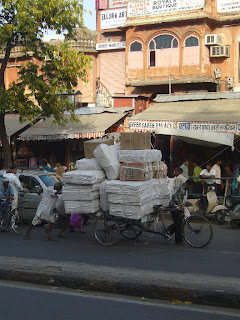
It is from the rickshaw that I do much of my observing of Delhi. The long stretches of kilometers that run through back alleys and over six-lane flyovers are not always conducive to foot travel. But a rickshaw grants you much of the same physical sensation as walking and the rides are never dull: I overhear snippets of conversations between drivers pausing at streetlights, catch a whiff of the chai sipped by groggy taxi drivers or a glimpse of families preparing for the day.  I see a city constantly at work: the same kids clamor at my side each day selling magazines, the dhobis teeter on their bicycles amidst traffic with oversized loads, the government Ambassador cars and the blue-plated SUVs of the United Nations whiz by authoritatively.


But these daily rickshaw rides offer more than sensory exposure and a series of near-accidents. They provide constant fodder for my work at Center for Social Research, the NGO with which I have been working since January.  The relevancy of Delhi’s street life to my project stems from the under-representation of one group: the women.


At the Center for Social Research, a 25-year-old women’s rights organization, I have been asked to author a leadership training manual for women aspiring to enter politics. Currently there is a pending bill that would establish a 33 percent reservation for women in state legislatures and Parliament. The course I am writing aims to mobilize women around political issues and empower them to see themselves as leaders. Our long-term goal—beyond providing women with information and training they may lack—is to pressure the government to pass the reservation bill through the voices of new women leaders.


When this project was first proposed to me, I hesitated. On the one hand, it had all the right elements: it was timely and stimulating, and would likely put me in contact with a wide cross section of society. On the other hand, I thought of the divisiveness of similar debates in the US and my role as a foreigner. I asked myself, “in my short time in Delhi, do I really want to enter into a debate as fierce and complex as something resembling affirmative action and quotas?”


Then I thought about my rickshaw rides through the streets and the teeming crowds: if there are so few women in daily public spaces, what would move them decide to run for political office, perhaps the ultimate of public positions? My curiosity peaking, I suspected the debate might be very different in India. 


I decided to turn outward. I contacted academics and NGOs, attended public debates, and spoke, through a translator, to local leaders. Through a series of interviews, I learned that the question of reservations in India, while just as lively and fierce as in the US, has a different starting point. Few dispute the disadvantage that certain social groups face in Indian society, particularly the lower castes and women. Reservations for lower castes are deeply entrenched in public sector institutions.  The debate around reservations for women concerns what we would think are the finer details but here, in such a populous and layered society, are the crux: numbers and percentages, and whether to address caste issues within or apart from reservations for women.


But it was not always this way. During the writing of the Indian Constitution, many leaders from disadvantaged groups felt that reservations were a way of ‘institutionalizing inequality’ and vehemently opposed them. The hope of unity and equality was too great. Sarojini Naidu, one of the most famous women leaders of India wrote: “To seek any form of preferential treatment would be to violate the integrity of the universal demand of Indian women for absolute equality of political status. We are confident that no untoward difficulties will intervene in the way of women.”


That was 1950. In 1993, India’s Constitution was amended to establish a one-third reservation for women at local (panchayat) level government; as I mentioned, there is a pending bill to do the same for state and Parliamentary legislatures. Some women question whether these bills will bring about the radical shift in gender roles we hope for. Generally, though, the women’s movement is supportive. So what changed?


Towards Equality, a report published in 1974 by the Commission on the Status of Women in India, suggested that independence had not created the opportunities for women that the writers of the Constitution had hoped. The Committee claimed that its field studies showed that the status of women had actually deteriorated in the preceding decades and called for stronger legislature and grassroots mobilization. Towards Equality galvanized the women’s movement; the report is considered to be one of its founding texts.


Addressing the breakdown between ideals and reality for women in Indian society in a way that is accurate yet empowering has been my primary focus in preparing this course. Ideals—progressive legislation, success stories—will play a crucial role in drawing women into the public sphere in greater numbers. We rely on the ideals to chip away at the harsh realities:


Men, Money, Muscle-power: the typical phrase used to describe Indian politics. Violence: against candidates and their families, against young women in pubs, against women at home. The exorbitant price of party tickets and the shady deals required to pay for them. The proxy debate, suggesting that reservations for women simply encourage men to put their wives forward to represent their interests.


The list of factors that could repel women from the public sphere and political leadership goes on and on.


The next set of questions I seek to address in this course concern the definition and cultivation of leadership: once a woman has decided to hold on to ideals and work to effect change in her surroundings, what does she need? What information and skills will encourage women and prepare them for leadership?


Parts of this answer are universal; many others are locally-specific. I have learned that the only way I can write an effective and relevant course to Indian women is to listen. Each individual I have spoken to has added to the definition and message of the course. Listening has deepened my ideas about politics, leadership, and women’s empowerment, sometimes casting them in a new light. Interviews with certain individuals, men and women, have been particularly instructive:


Sumitra, a woman who has contested two local village elections entered politics through her work in domestic violence. A survivor of violence herself, she became a local councilor and entered politics in order to be more effective in her work preventing violence. She has proven to me that the personal is political.


Atul, a PhD student at Nehru University, contested elections in his home district in northwest Bihar. He went door-to-door, introduced himself to his constituents, and listened to them in their homes. He lost, but received many more votes than expected. As a result, the opposition murdered his brother. Yet Atul plans to run again, showing that scare tactics are not universally effective.


Rheka counsels women experiencing domestic violence. She is fierce in her defense of her clients’ rights and radiates as she works. But she does not advocate total independence; instead reconciliation. She has shown me the ways in which a woman finds power is often relative to her surroundings.


Pallavi leads the student government at Nehru University. She was never interested in politics before she moved to Delhi from Bihar. At JNU she looked to her seniors for guidance, informed herself of the issues, and chose a party. She has shown me that, with strong mentors, an interest in politics can be cultivated, and that a community in which to learn is vital.


My friends from the States who have led wilderness trips spoke to me at length about activities and consciousness-raising exercises that encourage new leaders. They have convinced me that leaders are not necessarily natural-born; instead, most traits can be turned into a leadership skill. Knowing and listening to your own strengths is the first step towards leadership.  

I have started to see women leaders all around me. A woman I met last week at a domestic violence counseling center is filing a case against her husband while going to college and raising her child. My flatmate, a head editor at a magazine, turns on a dime from relaxing at home to making quick decisions on her phone. I am part of a vibrant running group organized by one community-minded woman who didn’t feel safe running alone. I think back to the self-help groups I visited while at my previous placement in Tamil Nadu, and the crucial role the women held in managing their families’ 

finances.


It is clear that my rickshaw rides and newspapers only tell part of the story. Women are scarce on the streets of Delhi; they comprise only 8 percent of the Lok Sabha. Off the streets women are organizing, taking charge of their lives, and reaching out to others. The goal of the one-third reservation bill is to bring this grassroots action to the public. To represent and facilitate women-focused leadership in politics.  To change the way political leadership looks.


I like to think that Sarojini Naidu would be appeased to consider that perhaps reservations are not a negative reflection of women’s capabilities. Reservations instead recognize the barriers between the public and the private spheres and the social structures that reinforce them.  Instead of ‘institutionalizing inequality’, reservations could actually recognize leadership potential and carve out doorways through the barriers. The doors will still be hard to open and women will need a good reason to push.  But as more women step through and leave the doors open behind them, the reasons will become more numerous and barriers increasingly porous.  

– Clara Presler

Author

  • admin
    admin
    View all posts
admin

Post navigation

Previous Post Previous
Next PostNext

You Might Also Like

September 03, 2026
Same Mission, Different Ethos
A Day in the Life: Jamshedpur Edition
September 02, 2026
What Is the Role of Life Skills Education?

Latest Posts

  • Same Mission, Different Ethos
    September 3, 2026
  • A Day in the Life: Jamshedpur Edition
    September 3, 2026
  • What Is the Role of Life Skills Education?
    September 2, 2026

Follow Us

Stay up to date on the latest news and help spread the word.

Support Our Work

Help transform the lives of millions of people in India.

Donate Now  See Your Impact in Motion
AIF-logo-white-300x99

The American India Foundation is a 501[c][3] organization committed to improving the lives of India’s underserved, with a special focus on women, children, and youth.

DONATE NOW
NEW YORK | CALIFORNIA
  • About Us
    • Mission Vision Values
    • History
    • Impact in Motion
    • Programs at a Glance
    • People
    • Knowledge Center
    • News and Updates
    • Blog
    • Financials
  • Our Work
    • Education
      • Digital Equalizer
      • Learning And Migration Program
    • Livelihoods
      • Ability Based Livelihood Empowerment
      • Market Aligned Skills Training
    • Leadership Development
      • Banyan Impact Fellowship
    • Integrated Programs
      • Support Adolescent Health Education & Livelihood Initiative
      • Skilling Nutrition Education and Health
    • Humanitarian Relief
      • AIF COVID-19 Relief Response
      • COVID Rehabilitation Fund
      • The First Million
    • Public Health
      • Maternal And Newborn Survival Initiative
  • Get Involved
    • Explore Our Chapters
    • Join Circle of Hope
    • Become a Young Professional
    • Create a College Chapter
    • Become a Youth Ambassador
    • Become a Corporate Partner
    • Start Your Fundraiser
    • Join a Mission Trip
    • Join an Event
    • AIF Arcade
  • Ways To Give
    • Light A Lamp
    • Donate Crypto
    • Give Stock
    • Give from DAF
    • Become a Monthly Donor
    • Start a Birthday Fundraiser
    • Leave a Legacy
    • Donate in India
    • Contact Us
      • Donor Portal
      • Inquiries
      • Careers
  • Donate Now
    • Give Once
    • Give Monthly
    • Humanitarian Relief
      • Donate to Nepal Flood Relief
      • Donate to Assam Flood Relief
    • Give to the Galas
      • Bay Area Gala
      • New England Gala
      • New York Gala
charity-navigator
gep-logo
guidestar
non-profit-logo
© Copyright 2000-2026 American India FoundationTM is a 501(c)(3) organization (EIN: 13-4159765)
Privacy Policy
  • PRIVACY
  • COOKIES
  • TERMS
  • PRICING
  • API
  • DATA

Follow us:

Subscribe to newsletter

Become a Fundraiser or Donate to Light a LAMP

Privacy & Cookies Notice
We use cookies and similar technologies to collect information and to personalize the site. By continuing to use this site, you consent to the placement of these cookies and similar technologies and to our privacy practices.

Read our updated Privacy Notice to learn more.
Accept all cookies  Cookie Settings
Manage consent

Privacy Overview

This website uses cookies to improve your experience while you navigate. Out of these, the cookies categorized as necessary are stored on your browser as they are essential for the working of the basic functionalities of the website. We also use third-party cookies that help us analyze and understand how you use this website. These cookies will be stored in your browser only with your consent. You also have the option to opt out of these cookies. But opting out of some of these cookies may affect your browsing experience.
Necessary
Always Enabled
Necessary cookies are absolutely essential for the website to function properly. These cookies ensure basic functionalities and security features of the website, anonymously.
Functional
Functional cookies help to perform certain functionalities like sharing the content of the website on social media platforms, collect feedbacks, and other third-party features.
Performance
Performance cookies are used to understand and analyze the key performance indexes of the website which helps in delivering a better user experience for the visitors.
Analytics
Analytical cookies are used to understand how visitors interact with the website. These cookies help provide information on metrics the number of visitors, bounce rate, traffic source, etc.
Advertisement
Advertisement cookies are used to provide visitors with relevant ads and marketing campaigns. These cookies track visitors across websites and collect information to provide customized ads.
Others
Other uncategorized cookies are those that are being analyzed and have not been classified into a category as yet.
SAVE & ACCEPT
55326088507_cfb3c39d82_z
55327217314_d3170dfbeb_z
55327418330_706ee45295_z
55326999221_dd05aa938f_z
55327215664_316a7e95a3_z
55327159633_e6611a9578_z
55326086597_bf1f2dafc8_z
55327161938_31321a5d4f_z
55327416140_066c9bbe4b_z
55327216419_f1fd1dc9cb_z
55326994101_e3409674c2_z
55327154373_c75309513b_z
55327156008_5e9316ba57_z
55327002316_48cd65ca3b_z
55327217634_4f1bb2d997_z
55327217854_904e0ea6ee_z
55327217139_28151b7ca8_z
55327002721_13df3dba30_z
55327418650_a3eaf0175d_z
55327417775_25a3efe985_z
55327418585_69454371cc_z
55295022115_495c9bc5d8_b
55293699227_1100d34999_z
55294998903_fcf6276958_z (1)
55295257085_4189543693_z
55293699602_a44b8cf1b3_z (1)
55294998823_22b1f4831f_z
55294844896_a81ccb1846_z (1)
55294611521_e14e12d38c_z
55294999178_1357596fb5_c
55294844896_a81ccb1846_z
55293935307_955ab8d3f0_z
55295085929_402beaf049_z
55294844171_327a23d9d0_z
55294843796_7eee300eef_z
55293934807_983306db41_z
55293934922_97490ccb18_z
55294997918_bd68b50a00_z
55295255930_87514247df_z
55294843206_9ee356b6f9_z
55294842516_c20d7c699a_z
55293932587_eb9c10dc05_z
55294841536_5c7842d9f8_z
55295254900_b32dfbd193_z
55294998903_fcf6276958_z
55293699602_a44b8cf1b3_z
55294845186_3b04736eb0_z
55295254255_0b29cda9a9_z

Start Your Collegiate Alliance Today!

Connect with us to learn more, request a fundraising toolkit, and ask questions about forming a collegiate alliance.

Subscribe for the Newsletter

Subscribe

Keep up with the latest AIF news and updates on our programs, events and campaigns

-

Please share the name and email of the person you would like to recommend:

To automatically download the marketing collateral, please share the following details:

Skip to content
Open toolbar Accessibility Tools

Accessibility Tools

  • Increase TextIncrease Text
  • Decrease TextDecrease Text
  • GrayscaleGrayscale
  • High ContrastHigh Contrast
  • Negative ContrastNegative Contrast
  • Links UnderlineLinks Underline
  • Readable FontReadable Font
  • Reset Reset