In an increasingly competitive market, companies are continuing to look for methods to obtain a strategic and economic advantage, whether through talent, productivity, or innovation. According to the National Centre for Promotion of Employment for Disabled People, only about 1% of India’s formal workforce comprises persons with disabilities, highlighting a vastly untapped talent pool (NCPEDP, 2020).
Employing people with disabilities (PWDs) is an often-overlooked tactic that has a significant impact. For far too long, inclusion in employment has been presented as a socially responsible or charitable endeavour. This viewpoint, however, ignores the enormous contribution that individuals with disabilities make. In addition to being the moral thing to do, hiring inclusively is a wise economic decision that promotes development, innovation, and profitability. Hiring inclusively is not just the right thing to do, it’s the smart thing to do.
Access to a Larger Talent Pool
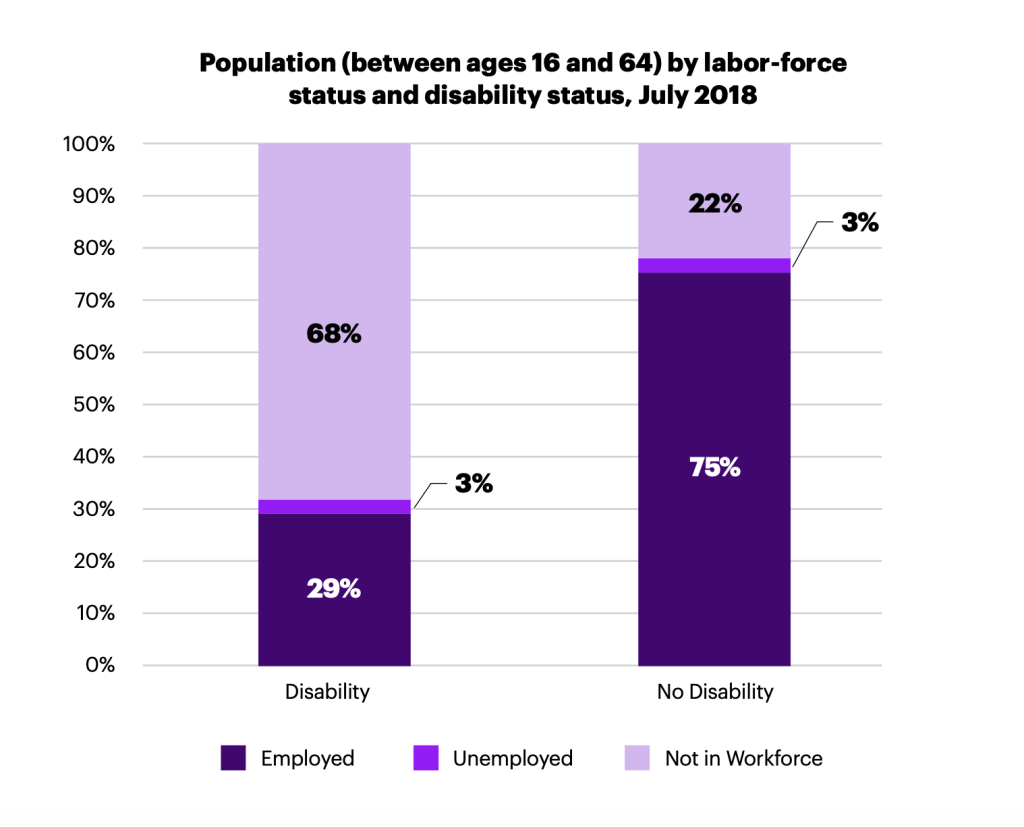
In India, there are approximately 30 million PWDs. Of this population, roughly 13 million are employable, but only 3.4 million are employed in both organized and unorganized sectors (The Economic Times, 2021). India is sitting on a significant talent pool of PWDs who can positively impact the changing landscape of this growing economy. Failing to prioritize the inclusive hiring of this overlooked population could cost India more than $210 billion (United Nations Development Programme, 2024). With the right government policies and social efforts in place to decrease societal stigma, millions of livelihoods can be enhanced. In the US, companies could gain access to a talent pool of an additional 10.7 million people by hiring with disability inclusion in mind, amounting to significant economic opportunity. By increasing the number of PWDs in the US labor force by just 1 percent, the GDP could see $25 billion gains (Accenture, 2018).
Moreover, fostering disability inclusion in hiring practices has a compounding effect on access to talent by making a company a more attractive employer to people without disabilities. An experiment conducted by Harvard Business Review found that job seekers were significantly more interested in a company and believed they would be happier if a considerable number of employees at the company had a disability. Even more, they indicated they would be willing to turn down a competing job offer with a higher salary to join the company that employs PWDs (Alemany & Vermeulen, 2023). Hiring inclusively pays dividends, not just by accessing the untapped potential of PWDs but also by providing a competitive and attractive offer to job seekers without disabilities.
Increased Bottom Line
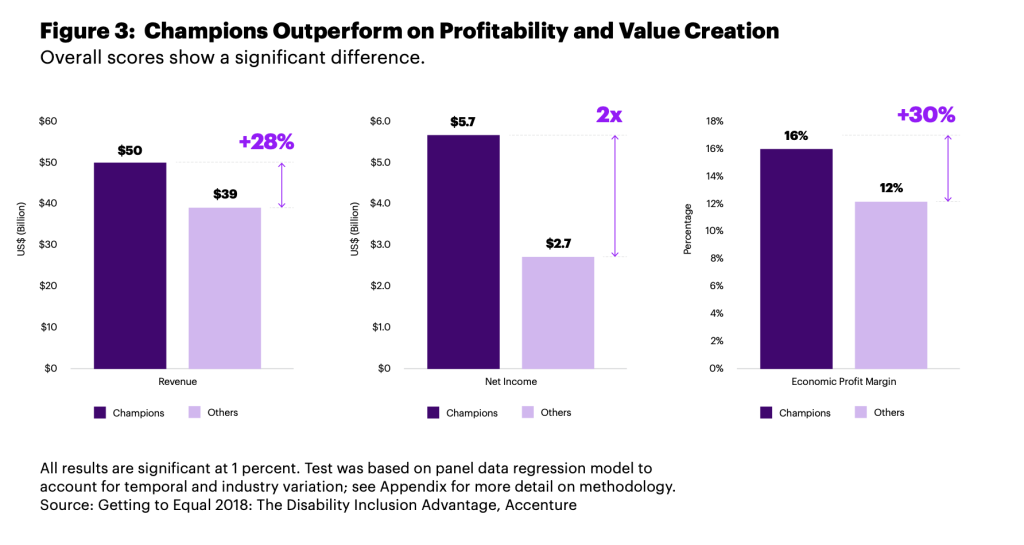
In the US, companies that champion disability inclusion recognize above-average financial gains. These companies see 28% higher revenue and 30% higher profit margins than their peers (Accenture, 2018). Although all companies should strive to champion disability inclusion, even incremental improvements in a company’s disability inclusion efforts achieve a ~50% outperformance of shareholder returns compared to industry peers (Accenture, 2018).
Critics will often claim that hiring PWDs comes with significant cost increases due to the necessary training, supervision, and accommodations required to successfully employ and retain this underrepresented population. However, these claims are generally unsubstantiated, and research shows the costs are relatively low compared to the strategic and financial benefits that companies yield through promoting disability inclusion in the workplace. The Job Accommodation Network, a service provided by the United States Department of Labor’s Office of Disability Employment Policy, found that the majority of employers (56%) stated workplace accommodations cost nothing to implement. Accommodations that do incur an expense will typically be a median one-time expenditure of $300, and employers report these accommodations to be “very effective” or “extremely effective” at helping PWDs perform necessary job responsibilities (Job Accommodation Network, 2024). Hiring with disability inclusion in mind also leads to greater creativity and innovation. A study by Deloitte India found that companies with robust diversity initiatives experienced a 15% increase in innovation and a 12% boost in profitability compared to their peers (Deloitte India, 2022).
Improved Employee Morale and Company Culture
Psychological safety is a critical component of cohesion and productivity for any company. Employees should feel safe and empowered to ask for help and seek guidance without fear of retribution. A study completed by Harvard Business Review found that HR professionals noted a 65% increase in feelings of psychological safety upon hiring PWDs. Additionally, 74% reported their teams were working better together, and 75% stated an enhancement in the atmosphere of their organization (Alemany & Vermeulen, 2023).
In India, a report by the Confederation of Indian Industry found that companies embracing inclusive hiring practices can see up to a 50% increase in employee morale and significantly enhanced team collaboration and workplace culture (CII, 2022). Increased diversity in the workplace can provide employees with constant opportunities for learning and increased personal and professional development. Employees are becoming increasingly more conscientious about workplace culture and company values. Hiring with disability inclusion in mind will ultimately reap long-term gains for employee motivation and organizational loyalty.
Conclusion
To hire inclusively is not just a moral obligation; it’s a strategic turn. It is one of the most vital investments a company can make to build sustainable future growth. When organization’s embrace diversity, they pave the path for increased revenue, innovation, and better productivity. DEI expert Verna Myers aptly puts it, “Diversity is being invited to the party; inclusion is being asked to dance.” It is time we craft a world that just doesn’t work for some but for everyone.
Co-authored by Haeli Juthani
References
- Accenture (2018). Getting to Equal 2018: The Disability Inclusion Advantage. Retrieved from https://www.accenture.com/content/dam/accenture/final/a-com-migration/pdf/pdf-89/accenture-disability-inclusion-research-report.pdf
- Alemany, L. & Vermeulen, F. (2024). Disability as a Source of Competitive Advantage. Harvard Business Review. Retrieved from https://hbr.org/2023/07/disability-as-a-source-of-competitive-advantage
- Deloitte India. (2022). Inclusive hiring and business performance in India. Retrieved from https://www2.deloitte.com/in/en.html
- Job Accommodation Network. (2024). Costs and Benefits of Accommodation. Retrieved from https://askjan.org/topics/costs.cfm
- National Centre for Promotion of Employment for Disabled People. (2020). Report on employment of persons with disabilities in India. Retrieved from https://ncpedp.org
- The Economic Times. (2021). Half of people with disabilities population in India employable: Report. Retrieved from https://economictimes.indiatimes.com/news/india/half-of-people-with-disabilities-population-in-india-employable-report/articleshow/84418292.cms
- United Nations Development Programme. (2024). Bridging the Gap: Enabling Disability Inclusion in India’s Private Sector Workplaces. Retrieved from https://www.undp.org/india/blog/bridging-gap-enabling-disability-inclusion-indias-private-sector-workplaces#:~:text=The%20workforce%20participation%20rate%20for,women%20with%20disabilities%20have%20jobs.