Recently, I had the opportunity to visit the headquarters of Access Development Services in Delhi, a national organization that focuses on empowering women and is also the host organization for my co-Fellow, Cora and her Fellowship project. Over the course of three days, I was invited to observe and learn about the training and support services that ACCESS offers for women with micro-entrepreneurship enterprises in their Advancing Women’s Enterprise (AWE) project. It was exciting to gain perspective on new approaches from the team, while also seeing how urban entrepreneurship looks different from rural entrepreneurship.

Variety of Entrepreneurship
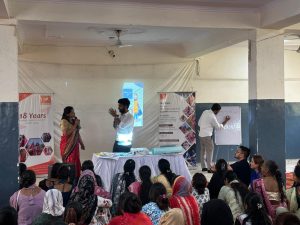
At the second training I observed, women from all over Delhi were sharing their different experiences with various business practices, like adopting UPI and how they kept inventory. Something that surprised me was how diverse the entrepreneurs’ businesses were, spanning resale shops for clothes or jewelry, women who designed their own home decor or bags, home-based enterprises where the entrepreneurs made food items and sold them, to chai and chaat stalls that dot the crowded streets of the city.
Comparatively, in our rural service area, most of the business loans are taken in just four sectors: agriculture, stitching/tailoring, small stores, and animal husbandry. This reflects a shift towards expanding existing family-based businesses or capitalizing on skills that women have already built up, as well as what they know can work in their areas. For both groups of women, home-based enterprises are accessible because they allow women to pursue independence in a way that is flexible to the other roles and responsibilities they take on.
Innovations
Learning about BuddhiMoney Didi, an interactive training program Access has built to build entrepreneurial skills, financial knowledge, and confidence in new entrepreneurs, was one of the highlights of the experience. The animated superhero videos provide accessible skill-building in approachable videos that reflect common problems for women growing as financial leaders. In addition to the videos and discussion sessions, using these videos as a base for peer-to-peer knowledge sharing conversations highlights the strength of the community they have built. These systems are ones I was excited to bring back and share with my project stakeholders.
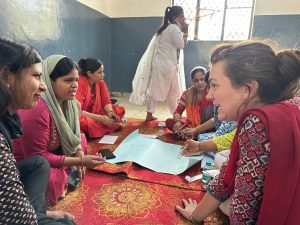
At Utthan, working with Sehnaz-ben, we’ve found success in a mentorship model, identifying goals and training as needed to work towards those goals. This requires more individual support, but makes cross-linkages across our related initiatives, like Krishi Sakhis Bio Resource Centers (BRCs), more approachable, due to the level of integration that our entrepreneurs experience. By supporting community leaders through multiple initiatives, Utthan is able to multiply impact acrosss their programs.
Challenges
While urban women have more access to aspects of digital infrastructure, that does not mean equity has been reached. One of the most popular services for both organizations was setting up UPI and connecting women to these digital systems. These processes often have regulatory barriers that make it difficult for new entrepreneurs to approach alone. Women who have businesses still have the same expectations in their family life. They build financial strength for their family and livelihoods for themselves, but in Delhi or in Bhavnagar, someone is still expected to make the roti, to clean the house, and to take care of the kids. Gendered labor distributions do not change, the hours of work only increase. The women I met are proud and empowered by their businesses, but share strategies for planning and managing their lives in addition to their business tips.
Next Steps
Access has been supporting women entrepreneurs for 19 years through a combination of incubation, training, and building accessible tools. Utthan, through the women’s saving cooperative, has a growing population of entrepreneurs, with over 2000 loans taken for Family Based Enterprises (FBEs). As India continues to build opportunities for women, it is imperative that rural women are not left behind and that solidarity is built across all environments to create solutions to these challenges. NGOs like Utthan and Access play crucial roles in incubating these nascent entrepreneurs and providing needed support for sustainable development.