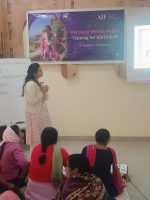
My AIF mentor Mollie Laffin-Rose and I were recently in the northeastern province of Assam, visiting the Purbanchal Maitri Development Society (Maitri). This non-profit organization trains domestic workers from the region and then finds them employment through its flagship Sahayika program.
The idea is simple: higher qualifications translate into higher pay. The nuances of operationalization, however, render this seemingly simplistic algorithm far more complex, a reality I have begun to appreciate in my time at AIF. In this respect, visiting Maitri has been particularly illuminating – being able to witness and participate in each stage of the Sahiyika program and speak with domestic workers, their employers and the program staff at Maitri has helped me a develop a more sophisticated understanding of the elements of a successful livelihood creation initiative in this sector. The program, like many of its kind, has three broad phases: outreach, training and placement. Our trip charted these stages, which are reflected below.
Outreach
Certain neighborhoods – some slums or bastis, some villages outside the city – are home to large numbers of domestic workers, in Guwahati and across the country. Maitri’s mobilization, therefore, focuses on the areas with large percentages of the city’s actual and potential domestic work force, targeting women already employed in private homes, as well as women with no previous domestic work experience who, judging by their economic and social profiles, are likely to enter the sector. Maitri uses three mechanisms in its outreach efforts: its own community mobilizers, local leaders who act as community anchors, and partnerships with microfinance institutions. The first and most conventional method includes door-to-door mobilization and organizing community meetings in slums and villages, whereas in the second, local figures such as village leaders and self-help group members are provided information on Maitri’s program that they subsequently disseminate. The third method – in which a member of Maitri’s outreach staff attends the loan repayment meetings of microfinance institutions and advertises the Sahayika program to the women present – seems the most innovative, in that it capitalizes on established relations between domestic workers and organizations. Maitri understands the power of personal networks in the informal sector and relies heavily on its program being spread by word of mouth. This system yields results: of the 20 Sahayikas I met, 18 had learnt about Maitri from friends or neighbors. Particularly interesting to potential recruits is hearing directly from a Sahayika, as a graduate of the program is called, and even more so if she is from the same neighborhood, since this facilitates greater identification.
Though it operates in a sector characterized by demand that far exceeds supply, Maitri faces few recruitment challenges: it trains and places approximately 40 Sahayikas each month. The organization believes that this is in part thanks to its Sahayika Sanyogi Scheme, which once again makes use of the extensive personal networks that many women employed in domestic work maintain. In this arrangement, an existing Sahayika receives incremental sums of money for each new recruit she brings to Maitri’s program. To check the quality of a system that could easily run amuck, the existing Sahayika’s reward is tied to the progress of her referral through the program – she receives half the sum once her friend is trained and placed, and the other half when the new Sahayika has completed six months of employment in her first placement. Recently, a Sahayika received Rs. 1800 for enrolling six friends in Maitri’s program under the Sahayika Sanyogi Scheme.
Most women who enroll in the Sahayika program have little or no previous work experience; of the ten women currently in training, four had worked before, in domestic work or tailoring, earning meager incomes. For the rest, Maitri’s placement will be their first job. In the lives of these women, Maitri represents a unique opportunity to contribute to their homes and families.
Training
Maitri runs two Sahayika training courses per month, each 15 days long, with three-hour sessions every day of the working week. The course comprises skills and practices related to housekeeping – some rudimentary, such as using gas stoves, which many women have never seen before, and others more complex, like north-Indian cuisine. Maitri’s trainers emphasize soft skills, like punctuality, decision-making, and effective communication. During the class I attended, the women were attentive and participative for the entire three hours, contradictory to the experiences of other organizations in the field.
To cultivate aspirations and develop the planning abilities of its trainees, Maitri conducts an exercise called ‘five dreams’. The women are asked to share five of their dreams, with the caveat that these be achievable in three years. One and a half years after the course, six Sahayikas remember this exercise, and all of them have realized at least one of their five dreams. Arti Rai, for instance, now owns a cell phone; Savitri Kalita is able to send her children to school, and Devi Amma manages to save Rs. 500 a month, just as they had all hoped to do. When Mollie and I asked the ten women currently in training to share a few of their dreams from the ‘five dreams’ activity, the resounding response was that they were going to save for their children’s education.
That the women enjoy the training is reflected in the experiences of veteran Sahayikas. The six Sahayikas who have been working for over a year now unanimously said they had enjoyed the training and felt very comfortable in Maitri’s office – enough to commute more than an hour by bus to attend the training sessions. Maitri addresses the issue of attendance by tying training to placement. If an aspiring Sahayika does not complete the training course, she will not be placed with one of Maitri’s clients.
Savitri Kalita, one of the six veteran Sahayikas, spoke of her heightened self-confidence after the training program; where she had earlier been afraid of approaching her employer and strangers, she now does so with greater ease. None of the other women present, however, were able to cite a particular skill that had been of especial use to them at work. But they did have a strong sense of community – they all attend Maitri’s monthly meetings and looked forward to the organization’s visits, to their own homes or at those of their employers, saying it made them feel like Maitri cared. And all of Maitri’s Sahayikas earn Rs. 3500 a month, with two days of guaranteed leave – pay and working conditions far better than what most of them originally had. A support network and sense of belonging, combined with higher pay, comprise a significant achievement. Therefore, perhaps the content of training is not the most important factor in an organization like Maitri; rather the role of such an organization, more than impart instruction, is to build communities and foster a dignified workspace. While training is immensely valuable to this end, perhaps it will serve us well to remember that it is only one instrument among many in transforming the domestic workspace.
Mollie shared an interesting question in regard to the training component of any domestic worker skilling program. If skills and knowledge catalyze greater income, is it not preferable to conduct the most intensive training possible for domestic workers? Or is a minimum standard of workforce readiness, which would allow these women to become economically active, a more realistic goal? Perhaps the most pragmatic reconciliation of idealism and realism in this context is a model that allows relatively fluid movement between the work place and the classroom, allowing women to upgrade their skills simultaneously or alternately with their work.
Radha Sarkar is a fourth-year student at Princeton University, New Jersey, pursuing a Bachelor’s degree in Political Science. She is interning with AIF’s MAST program, focused on skill development in the domestic work sector. In the recent past, in order to address the needs of the millions of women who work informally in homes, AIF has begun to understand and champion for the professionalization of domestic work under its MAST program.