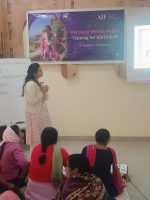
Alice Repetto is one of three Google employee volunteers at the American India Foundation in Delhi, brought there by the Google Reach program, which allows Google employees from all over the world to work closely with an international NGO. The volunteers have been tasked with conducting an overview of the Digital Equalizer program, finding its unique benefits to students and teachers, and creating a comprehensive strategy for how to market these benefits to corporate donors in India. They have visited multiple Digital Equalizer program sites in order to gain knowledge of how the program impacts its communities. Below, Alice gives her account of several of these visits, and her thoughts on their project so far.
“To make the most of this experience, you guys should spend most of your time visiting our operations on field.” That was the main advice we got from Dr. Hemanth Paul, AIF Country Director, when we met him during our first day as volunteers for the American India Foundation (AIF).
Mike, Morten, and I came to India from different countries (Denmark, California, and Italy) with different professional expertise (Business Development and Marketing) but a common goal: to use our skills to help AIF to address India’s top educational challenges through technology. Given the limited timeframe at our disposal (three weeks), we decided to focus our support on reinforcing the selling proposition for AIF’s education project, Digital Equalizer (DE) to get more funds from donors by proving its positive impact on students. To achieve this goal, we went on field visits and spoke with several people involved in the programs, including school principals, teachers and students, and Digital Equalizer trainers.
Our first visit was arranged in SKV Pushp Vihar public school in Delhi where Digital Equalizer had been running for 3 years, providing computer labs funded by Dell and teacher training for computer skills. The principal gave us some insights on the challenges that the education system faces in India – high absentee rate, school dropout especially among girls, and lack of teachers’ preparation. The most exciting part of the visit was indeed the contact with the students. We had the chance to attend a science lesson in a classroom of 12 years old girls who were studying photosynthesis with the help of digital tools (a projector, videos, and an online quiz to assess their learning). We were truly impressed by both the discipline of the students and the sophisticated teaching methods made possible by technology that allowed the teacher to explain and visualize the complex biological processes.
Another interesting visit was held in RK Puram District Institute of Educational Training (DIET) School, where Digital Equalizer has recently been introduced to train students aiming to become primary school teachers. My most vivid memory of this experience was the informal discussion with the students about our personal and professional ambitions. It was really interesting to discover that we had very similar dreams! Both us Googlers and the DIET students wanted to play their part in changing the world, providing access to information and empowering people to get more confidence to face everyday issues/opportunities through education and technology. In talking to the students, we also noticed a significant difference between students from private and public schools in terms of tech savvy – while the private school students were very familiar with computers and the Internet because they used them in schools, the public school students were using this technology for the first time during the Digital Equalizer trainings at the DIET. Despite the different backgrounds, both groups of students considered technology to be a good source of information to prepare the lessons as well as a helpful aid to improve students’ attention, drive more engagement, and inspire them to become active knowledge seekers in their lives.
One particular former student, a graduate of the VEDIC KANYA HIGH SCHOOL in Gurgaon, was significantly impacted by AIF’s Digital Equalizer. This student – Mohit – was introduced to technology in this school a few years earlier, and from that moment on, his passion for computers has never abated. He used to spend most of his time in the AIF-Funded computer lab, browsing the Internet and discovering the world. His dream is to become a software engineer, and he is working during weekends and over his summer break to pay his exam preparation for the college so that he may achieve it. We were all incredibly touched by his passion, maturity, and restless determination to accomplish his dream, with the end goal to improve people’s lives through technology and information.
All our visits were very inspiring and I feel enriched on a personal and professional level; I strongly believe that the biggest take-away of this experience came from the people we met and hearing their stories. The magnitude of the challenges they are trying to overcome is overwhelming, but we learned that expertise, persistence, and ultimately passion, can make a difference and impact millions of lives. We are extremely grateful to AIF for inspiring us to apply the same approach in our own lives.
Alice Repetto is head of consumer marketing for Google in Italy with the mission to earn the love of Internet users and drive adoption of strategic products. Among her top achievements are successful marketing campaigns making Chrome the #1 browser and Google+ the #2 social platform in Italy; Technology for Good initiatives (Memory of a Place, Action For Women, and Internet 4 Peace); and contributing to build 94% Google favorability in her Country. She started her career at Rai Cinema, supporting the film industry with consumer insights, and she felt in love with new media during her following experience at Buongiorno SpA, working on interactive cross-platform formats.